The year is 1985. DOS is barely out of its infancy, graphics cards count colors on one hand, and someone decided to write a helicopter game. The result is called Striker, and it's exactly as modest as it sounds.
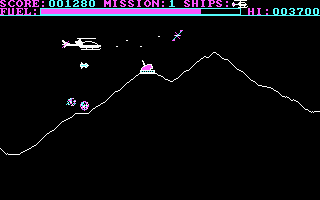
Striker is an action game where you pilot a helicopter through five missions and eliminate enemies — both ground and airborne. No complex plot, no dialogue, no cutscenes. The goal is simple: fly in, destroy, fly out. In 1985, that was enough.
The mechanics are straightforward to the bone. You move across the screen with cockpit cannons for air targets and bombs for anything crawling or standing below. Weapon choice depends purely on the situation — enemy in front of you gets a burst, enemy below you gets a bomb. The game asks nothing more of you. The controls are simple, perhaps even too simple, but on 1985 hardware, every unnecessary keypress was a luxury.
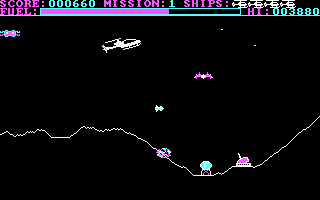
Why do we even remember Striker? Because it's one of the oldest surviving DOS clones of the then-popular genre that thrived on arcade shooters and early flight action games. Derek Williams wrote it at a time when developer, publisher, and tester were the same person sitting at one computer. This simplicity is also its greatest weakness today — after five minutes, you've reliably mapped everything Striker can do. It doesn't age badly because it doesn't age at all — it remains exactly where Williams left it.
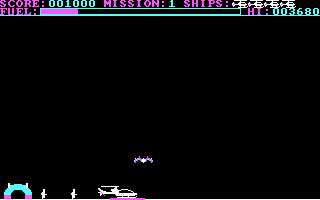
Today, Striker appeals to a narrow audience: historically curious players who want to see what an action DOS title looked like at the absolute beginning of the platform, or those who want ten minutes to recall the era when smooth movement was a relative concept. Fire it up in your browser via DOSBox emulator instantly with no installation — and that's probably the most convenient way Striker has ever been possible to run.
 old
old


 ▶Doom1993MS-DOS / PC


 ▶Contra1988MS-DOS / PC
 ▶Ultimate Mortal Kombat 31996Super Nintendo
