Αυτή η κριτική δεν έχει μεταφραστεί ακόμη — εμφανίζουμε το πρωτότυπο (English).
You're shooting at German soldiers across a space filled with nooks and locked doors, and not without taking a bullet yourself. Castle Wolfenstein from 1984 is one of those games you can count on the fingers of one hand — we told ourselves back then that this simply wasn't possible.
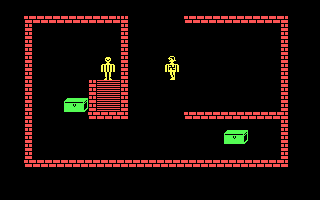
You're off on an adventure in a Gothic castle full of Germans, shooting your way through levels from top to bottom. You don't mess around with the map, you go in, look around, and start crawling on the floor so you don't get swept off the map. The game won't let you plan — shoot or die. Only those with steady nerves and lightning-fast fingers command respect for pulling it off.
The controls are crude, but they work. Keyboard, sometimes joystick, movement is stiff, but once you get it in your fingers, you feel a strange poetry in it. You never go where you want to go, you go where you manage to. The music from the speaker — if there was any at all — doesn't stick in your brain, but the sound of gunfire and the growl of German voices? That's the thing. You have various weapons and you feel their effectiveness every second.
Castle Wolfenstein was ahead of its time. It was a glimpse of what everyone later did in Doom. Only later did it become clear how much it valued technology — and how quickly it would age. These days it doesn't hold up when you launch it out of pure curiosity, but for those of us who want to know where it all came from, it's as important as a dead language.
It'll appeal to you today if you're interested in what computer games looked like when they still looked like geometric abstractions. In a browser, almost every enthusiast has played it — it's broken, it's brilliant. You know what it tastes like, that oldness, when a bullet hits you and your little guy falls to the ground.
 old
old


 ▶Doom1993MS-DOS / PC


 ▶Contra1988MS-DOS / PC

 ▶Ultimate Mortal Kombat 31996Super Nintendo
