Summer 1992, sweltering heat, blinds drawn halfway, and someone's calling on the phone asking if you're coming to "those computer games." California Games II has the perfect answer: yes, come over, bring your willingness to lose.
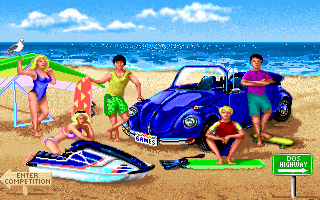
Epyx released California Games II in 1990 as a sequel to their popular sports anthology title. Like its predecessor, it builds on a simple concept: take a handful of action sports typically associated with Californian culture, throw them into one package, and let people compete. On the agenda are disciplines like surfing, snowboarding, and BMX — basically things we in the Czech Republic knew about mostly from videotapes and David Hasselhoff.
Each discipline has its own control scheme and its own logic. Some are intuitive within five seconds, others took an entire afternoon to understand — and I probably never quite figured out a couple of them, which didn't seem like a problem at the time because my friend was in the same boat. The game lets you play either individual events or a full tournament for up to seven players. That was the real heart of it. Nobody bought California Games for single-player. You bought it so you could compete on one keyboard and argue about whose score showed up first.
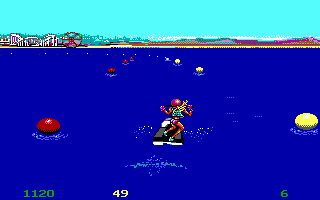
What's held up to this day is that social structure — quick turn-taking, instant result comparison, no complex menus between rounds. What's visibly aged, however, is the control precision. Some disciplines rely more on hitting buttons at the right moment than actual skill, and the timing behaves irregularly on a couple of them. Back then I blamed my own clumsiness. Now I know it was sometimes just the code.
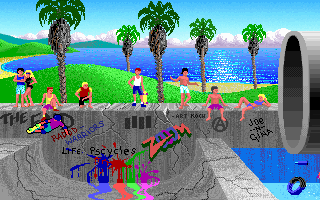
Today California Games II works best exactly as it did then — as a game for two people at one monitor who want to prove who's better at anything lasting thirty seconds. If you're looking for a deep sports simulator, you're in the wrong place. If you're looking for a reason to remember what computer sports looked like before FIFA and the pre-season transfer window, this is it. You can fire it up in your browser with zero installation — and that's exactly the kind of convenience that didn't exist back then.
 old
old


 ▶Lakers vs Celtics and the NBA Playoffs1989MS-DOS / PC


 ▶Championship Manager 93-941993MS-DOS / PC
 ▶Winter Games1986MS-DOS / PC


 ▶European Club Soccer1993Sega Mega Drive