Bài đánh giá này chưa được dịch — chúng tôi hiển thị bản gốc (English).
The year is 1986, a CGA monitor breathing heat into your face, a graphics card spewing four colors in shades that today look like the result of a lost bet, and I'm flipping through an atlas of the United States because the game tells me the suspect was spotted in New Orleans and had a taste for Cajun cuisine. I was learning geography from maps and from this software all at once.

Where in the USA is Carmen Sandiego? launched in 1986 from Brøderbund as a direct follow-up to the original worldwide game. While its predecessor sent players across continents, here the sphere of action narrowed down to fifty American states. Genre-wise, it's edutainment in its purest form — a detective logic game that subtly gets you to memorize state capitals, rivers, and local specialties without feeling like someone's trying to educate you.
The principle is simple: you get a case, follow clues through witnesses and evidence, combine information, and try to catch a V.I.L.E. agent before time runs out. You need to correctly identify the suspect from the database and gather enough evidence to make an arrest. Navigation through text menus works without a hitch even today, and the pace is deliberately slow — that's not a design flaw, it's space for thinking. The CGA version looks rougher than later EGA or VGA remakes, sure, but anyone who first experienced this game in exactly this form will tell you those four colors simply belong to it like the smell of an old manual.
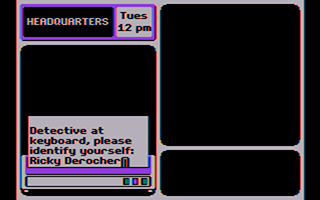
The Carmen Sandiego series became synonymous with edutainment of the 80s and 90s, and this first American spin-off proved the formula worked without a world map too. It's aged predictably — the suspect database is limited, after a few cases you spot the patterns and the tension fades. But it was 1986 and this was mainstream educational software, not a roguelike with procedural generation. Judging it through today's lens would be as fair as blaming a Volkswagen Beetle for not having ESP.
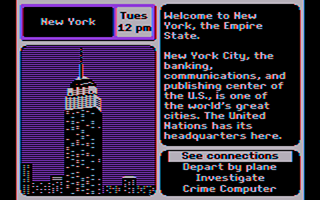
Today this version appeals mainly to those who remember it and want to verify whether their memories are accurate — or to those curious about what edutainment looked like before everyone figured out how to water it down into a toothless mush. Fire it up in your browser with no installation or configuration needed. Half an hour per case, keep a USA map handy — not because you can't play without it, but because you'll play better with it.
 old
old


 ▶Tetris1985MS-DOS / PC

 ▶Boulder Dash1984MS-DOS / PC

 ▶Teenage Queen1988MS-DOS / PC
 ▶Sokoban1984MS-DOS / PC

 ▶Supaplex1991MS-DOS / PC
 ▶Vlak1993MS-DOS / PC
 ▶Chess1998Sega Mega Drive


