I remember the first time I saw Galaxian on my friend's monitor — it looked like Space Invaders, but faster and somehow more alive. And that was the whole difference.
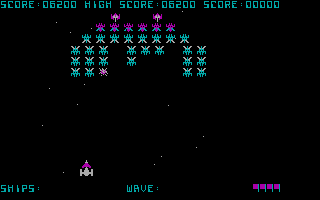
Galaxian is an arcade shooter from Namco, originally from arcade cabinets in 1979, it came to PC DOS in the early eighties. The premise sounds familiar: you control a ship from the bottom, and a formation of aliens arranged in rows awaits you from above. The task is simple — blast them all to pieces.
But unlike Space Invaders, the enemies here don't stay calmly in formation slowly creeping down. Selected individuals fly out from the formation, swoop down in an arc while firing at you. It's this very dynamic that makes Galaxian feel more alive. You're not just moving left and right, mechanically tracking the movement of the entire mass — you have to react to unpredictable attacks. The higher types from the upper ranks are worth more points, but they're also more dangerous. It's not deep strategy, but for 1983 it was a decent step forward. The PC version at the time offered modest graphics and sound on the edge of tolerability, as was typical for DOS ports.
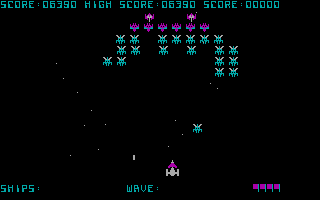
What Galaxian brought was the realization that enemies in arcades don't have to be passive. The attacks are scripted, you'll memorize them over time, but that moment when three of them fly at you at once and you have one shot and half a second — that still works today. The controls on the PC version aged badly, being dependent on specific hardware and settings, and on a modern machine without an emulator it simply doesn't work. And the graphics — well, that's a museum piece, not a criticism.
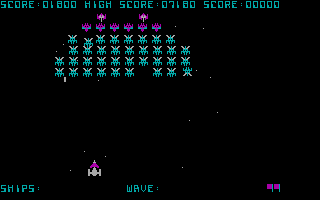
Today you can play Galaxian in your browser via emulators like JS-DOS or directly on Archive.org, no installation and no headaches. It'll appeal to anyone who loves pure arcade mechanics — no story, no upgrades, just reflexes and score. If you know Galaga, which came out two years after the original arcade and directly builds on Galaxian, you'll know what to expect. If not, Galaxian is a good starting point — ten minutes to understand why such games spawned an entire industry.
 old
old


 ▶Doom1993MS-DOS / PC


