این نقد هنوز ترجمه نشده است — متن اصلی (English) را نشان میدهیم.
Year 1985. While other RPGs were busy figuring out who the main villain was this time and how to kill them, Richard Garriott came up with a question that really scrambled my brain as a kid: what if you were the problem? Ultima IV had no final boss. It had you.

Quest of the Avatar is the fourth installment in the Ultima series from Origin Systems and also the point where the series came of age. The goal of the game isn't to defeat evil — it's to become the Avatar, a spiritual exemplar for the inhabitants of Britannia. To do this, you need to master eight virtues: honesty, compassion, valor, justice, honor, sacrifice, spirituality, and humility. Each virtue corresponds to a character class, a city, a dungeon, and part of the final puzzle. It's an elaborate system, almost impossibly ambitious for 1985.
You play in a combination of top-down perspective when traveling the world and first-person view in dungeons — a period standard that worked. The combat system is turn-based and solid for its time, though nobody would praise it for depth today. What holds the game together is exploration and logic: the game tracks your actions, not just your stats. If you steal goods from a shop or attack a neutral creature, your virtues decrease. This was a small miracle of game design in 1985.

Ultima IV is also the game where I remember first feeling that an RPG could have a real moral framework. Not the paper kind — chaotic evil, lawful good — but something that showed itself in how you behaved in the game. That said, I'll be honest: the technical side aged hard. The interface is bare-bones, navigating the map without a guide is tedious, and disk access on period hardware was torture. These days you run it in an emulator or browser and that goes away, but the mental model of the game still demands patience and a notebook next to your keyboard.

Ultima IV suits anyone who wants to see where modern RPGs with moral choices were born — from Baldur's Gate through Planescape to today's titles. It's not a museum piece behind glass; it's still playable and still has something to say. Starting the series with the fourth entry is also a smart call: the first three are historically interesting but brutally unforgiving. Here Garriott finally knew what he was doing. And most of the time, he did it well.
 old


 ▶Dungeon Master1989MS-DOS / PC


 ▶Doraemon: Giga Zombie no Gyakushuu1990Nintendo NES
 ▶Light Crusader1995Sega Mega Drive
 ▶Phantasy Star IV1993Sega Mega Drive


 ▶Fallout 1 Prototype1997MS-DOS / PC

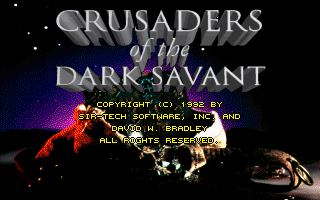 ▶Wizardry 7: Crusaders of the Dark Savant1992MS-DOS / PC
 ▶Heroes of Jin Yong (金庸群侠传)1996MS-DOS / PC