Αυτή η κριτική δεν έχει μεταφραστεί ακόμη — εμφανίζουμε το πρωτότυπο (English).
Sometime in 1992, I was sitting at my computer and for the first time got my hands on a tool that taught me that democracy is just a matter of handing out contracts correctly. Floor 13 isn't a game about heroism. It's about dirt.
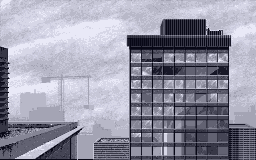
You play the head of a secret government agency somewhere deep in the bowels of British bureaucracy — the thirteenth floor, which officially doesn't exist. Your task is to keep the ruling party in power at any cost. Journalists writing unpleasant articles? The opposition gaining support? Someone knows too much? You deal with it. You choose the methods — surveillance, intimidation, abduction, discrediting. The game gives you the tools and lets you decide how far you're willing to go. The Prime Minister trusts you. For now.
Mechanically, it's about managing agents in real time — each day you get reports, assign people to tasks, and wait for results. The interface is sparse, text-based, with no animations. The game doesn't hold your hand and doesn't explain the consequences of every decision in advance. You'll discover you came down too hard on the journalists when the scandal blows up even bigger. Or when an agent goes missing and you don't know why. This kind of uncertainty is deliberate and it works. The tension doesn't come from shooting, but from not knowing whether you've done enough — or too much.
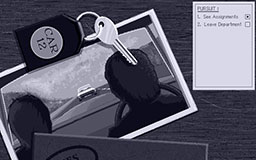
What set Floor 13 apart in 1992 was the subject matter. Most strategies of that time dealt with wars, space, or economics. Here you're the power apparatus of democracy, functioning exactly the way democracy shouldn't function — and the game doesn't look at it with a moralizing finger, just presents it to you as fact. It was provocative and a bit unsettling. It still is. The interface has obviously aged, the pace is slow, and the sound design was modest back then, practically nonexistent by today's standards. But the core — that cynical state power simulator — holds up surprisingly well.
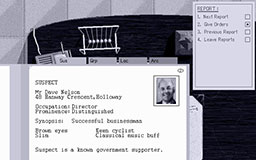
Today, Floor 13 is best played by someone who loves atmosphere-driven games and is willing to read. It's not action, it's not fun in the sense of blowing off steam. It's a game that after half an hour starts asking you uncomfortable questions — and that's precisely why it's worth trying in your browser. Twenty minutes won't cut it. But you'll think about it the next day.
 old
old


 ▶North & South1990MS-DOS / PC


 ▶Teenage Queen1988MS-DOS / PC


 ▶Chess1998Sega Mega Drive


