Цей огляд ще не перекладено — показуємо оригінал (English).
Year 1989. The oval at Indianapolis is on lap twenty-three and I'm sweating because I've overrevved the engine on the backmarker. No smiling ducks at the track's edge, no bonus for third place. Just a bare number on the tachometer and the question of whether I'll make it to pit lane before the engine gives up for good.
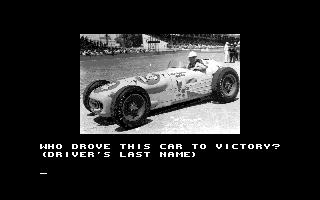
Indianapolis 500: The Simulation by Papyrus Design Group is a racing simulator — and the word "simulator" here isn't a marketing trick. The game takes place exclusively on the legendary Indianapolis oval, covering the racing weekend from practice sessions through qualifying to the race itself. No European circuits, no varied scenery. Just two and a half miles of asphalt and four turns you'll learn to hate and love at the same time.
The controls are unforgiving. The car's physics respond to overrevving, to a poorly chosen line, to the wind from rival cars during overtaking. Setting up your own racing machine — suspension stiffness, gear ratios, downforce — was something unexpected for a PC game in 1989. Most people raced in games back then where it was enough to hold down the forward key. Here, the game would humble you thoroughly for the first half hour. Then you'd start understanding what you were actually doing.
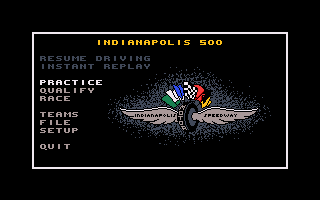
With friends back then, we came up with our own way to play with multiple people — we'd take turns at the keyboard and every crash had to have consequences. A sort of primitive hot-seat rule born from desperation, since multiplayer obviously didn't exist. Looking back, I have to say it worked surprisingly well. The game had enough physical consequence to make even that approach feel meaningful.
What's aged poorly? The graphics are obviously blocky by today's standards and the oval monotony of the track makes itself felt after ten laps. Whoever wasn't hooked by the Indianapolis oval in 1989 won't be hooked today either. And if you're expecting the variety of F1 races with different circuits, you'll be disappointed — that's simply a different game.
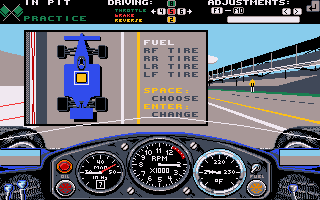
What stands the test of time? The physics model that Papyrus would develop further in later titles like NASCAR Racing and Grand Prix Legends. Indianapolis 500 is their first attempt and you can see where that approach got its start. For racing fans with a historical bent, it's a first-class curiosity. For everyone else — if you're curious to experience what a "serious racing sim" looked like before that term even existed, give it a try. Twenty minutes is all it takes to understand why people remember it forty years later.
 old
old


 ▶Test Drive1987MS-DOS / PC


 ▶Pitstop II1984MS-DOS / PC


 ▶F11993Sega Mega Drive


