Bu inceleme henüz çevrilmedi — orijinalini gösteriyoruz (English).
When Richard Garriott started writing Ultima in the early eighties, he didn't have a programmer, a budget, or a team. He had: an Apple II computer, determination, and a name called Akalabeth. With this piece of code, he paved his way to legend.
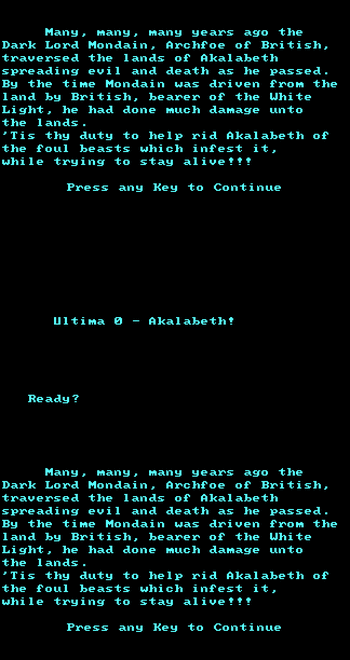
It's the first dungeon crawler that ever tried to be something more than a sequence of random wanderings through dark corridors. You create a character, get maybe a sword and magic glasses, then transport yourself into a blood-red world where a single massive castle awaits you, full of monsters, treasure, and secrets. The goal is simple: find Mondain and finish him.
You play from a first-person perspective, one step at a time, as if you were navigating through a dungeon on your turn. There are four directions, the same graphics over and over, a simple button for attack or magic. No combinations, no energy system, no elegance. Just you, the monsters, and the question: do you have enough courage, or will you go back and reload your save? Mistakes are deadly, and you won't learn to avoid losing your character gracefully.
Akalabeth was never officially released. Garriott sold it in the lobby of a computer store in a retail mall for ten dollars, in a plastic case with a handwritten label. Later, California Pacific Computer Company appropriated it and cheated the creator out of his royalties. Yet it became the first milestone in a series that transformed computer RPGs from a sci-fi gimmick into a lifelong obsession for millions.
It plays unnecessarily hard by today's standards. The graphics are bare-bones notation, the interface feels like a puzzle where you have to learn all the secrets by word of mouth. But that inhospitality is precisely where its power lies: it's pure origin. No guidance, no tutorial, no mercy. You're alone in the dungeon with a sword and minimal information. This is what players were doing forty years ago — and it was magical.
 old
old


 ▶Dungeon Master1989MS-DOS / PC


 ▶Light Crusader1995Sega Mega Drive


 ▶Doraemon: Giga Zombie no Gyakushuu1990Nintendo NES
 ▶Space Rogue1989MS-DOS / PC
 ▶Wizardry 7: Crusaders of the Dark Savant1992MS-DOS / PC