Bu inceleme henüz çevrilmedi — orijinalini gösteriyoruz (English).
I remember exactly the feeling when I first saw Dig Dug on a school computer — someone scored it on a floppy disk from somewhere, and we spent half the break watching this little guy pump a monster so hard it just... vanished. That hit me harder than actually playing it.
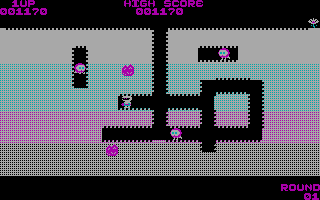
Dig Dug hit arcades in 1982 and came to PC shortly after. Namco bet everything on a simple but clever concept: you control a character in a jumpsuit, digging tunnels through the ground while avoiding enemies — Pookas and Fygars. The goal is to clear each screen of all monsters either by direct elimination or by dropping a boulder on them. No story, no plot twists. Pure arcade math.
The mechanics rest on two pillars. First is the digging — you create the tunnels yourself, which defines the battlefield, and that was surprisingly fresh back then. Second is the pump: you get close to an enemy, start inflating them, and have to pump fast enough for them to explode, otherwise they deflate and happily move on. Boulders drop when you undermine their support, and a well-aimed rock can wipe out a whole group at once and seriously boost your score. Controls are straightforward, but panic sets in when enemies start chasing you through your own tunnel — that fear is authentic even now.
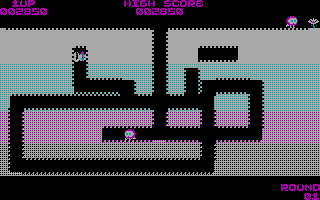
What holds up? The rhythm. Dig Dug has a pace you can't fake — the more monsters you remove, the faster the survivors get, so the last creature on screen turns into a paranoid chase. A bit like Pac-Man, but with an extra spatial element. What aged less gracefully? Repetition. After ten screens you've seen everything and the game offers almost nothing new. In 1983 nobody cared — arcades lived on quarters, not depth. On a home PC, you feel it faster.
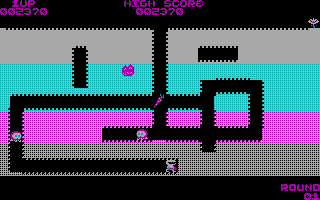
Today Dig Dug appeals mostly to people wanting to experience what grew into entire genres of tactical movement and territory control — and those who just want to switch their brain off and chase high scores. The game fits one afternoon, needs no manual, and runs in your browser without fuss. It's not my favorite thing from that era, but I can't deny Namco's honest work.
 old
old


 ▶Doom1993MS-DOS / PC


