Sometimes a game grabs you at first glance, sometimes it takes playing it five times in a row. Exploding Atoms is that kind of quiet beast — not much happens on screen, but your mind never stops figuring out what to do next.

It's a logic game that some unknown workshop released in 1992 on MS-DOS. The playing field is a grid of squares where you place atoms — colorful balls whose only job is to blow each other off the map. When two atoms of the same color end up next to each other, they explode. The goal is simple: get rid of all the atoms and leave the board empty at the end. Simple. Fatal.
You play it with a mouse on a DOS machine that didn't have to worry about intensive graphics. Squares are marked, atoms are dragged or rotated — every move matters. There's no rush, no lives at stake, no need to hammer the keys. Room for strategy is enormous. Sometimes you realize you've trapped yourself with no way out. Then you start over. That's the whole psychology of the game — quiet pressure. No tricks, just your decisions and their consequences.
What happens in it fits the computers of that era perfectly. The graphics are bare-bones — monochromatic background, colorful balls, cursor. Sound? Minimal. But that's exactly how the game works with your brain — it gives you space to focus. Today someone would dress it up with animations and sound effects, and might destroy what makes it interesting in the process.
It's not a game for everyone. If you're looking for action or story, you won't find any of that here. But if you love that quiet tension between math and logical self-restraint, if you enjoy the feeling of solving a puzzle just by sitting down and thinking — Exploding Atoms is your game. You can't buy it anywhere anymore, but in an emulator a few minutes will drive home what kind of freedom computers had in the nineties when it came to paradoxically difficult problems.
 old
old


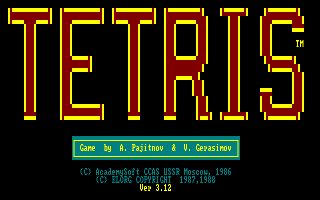 ▶Tetris1985MS-DOS / PC
 ▶Teenage Queen1988MS-DOS / PC
 ▶Boulder Dash1984MS-DOS / PC
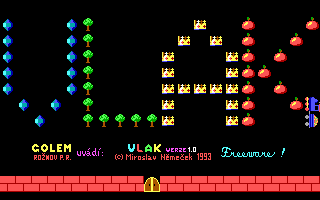 ▶Vlak1993MS-DOS / PC
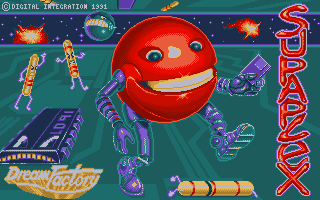 ▶Supaplex1991MS-DOS / PC
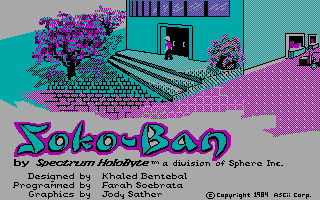 ▶Sokoban1984MS-DOS / PC


 ▶Boulder Dash III1986ZX Spectrum


 ▶Chess1998Sega Mega Drive
