Denne anmeldelse er endnu ikke oversat — vi viser originalen (English).
3D tic-tac-toe sounds like the kind of thing that teaches you to think like a computer. Reality is milder — this is a quiet, black-and-white strategy game from 1992 that fascinates you for the first quarter hour and then stops holding your interest. The board isn't square like on paper, but a four-by-four-by-four cube, and instead of three marks in a row, you need five.
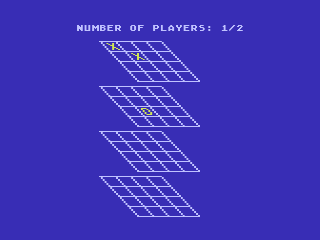
You sit across from the machine and take turns on a 3D grid. Graphics? Two colored surfaces and lines, a skeletal overhead view of that cube. Sound? Silence and the occasional beep when you click. Your mind has to navigate across multiple levels at once — what you see is just one slice, the remaining layers escape you, and this is where the charm of flat tic-tac-toe goes missing. Whether you lose your bearings due to the inherent complexity here or simply because the game is played poorly — hard to say.
The AI plays reasonably, but without brilliance. It defends against your attempts and attacks when it can, yet there's no sign of any higher strategic vision in the computer. You, meanwhile, feel like you're playing blind — three or four moves in and you don't know what's happening on which level. The game would need better visualization, maybe rotation or transparent layers, but you get only an orthogonal view and a list that leads you into mistakes.
Ultimately, it's proof that not every interesting idea works on screen. It interested you. You played it for twenty minutes. Then you went back to Tetris or MUD. Today you remember it purely through a retro lens — an interesting experiment from when people were still figuring out what you could do in DOS.
Not worth hunting for. But if you stumble across it online as a scientific curiosity, at least try five games. It'll teach you to think spatially, even if it won't be fun. Sharp logic without joy — that's its DNA.
 old
old


 ▶Teenage Queen1988MS-DOS / PC
 ▶North & South1990MS-DOS / PC


 ▶Sid Meier's Civilization1991MS-DOS / PC


