Summer 1982, an empty computer lab at the University of Washington. Doug Smith was tasked with looking after the room, but nobody really came by in summer. So he decided to kill time his own way — and wrote Lode Runner. The game, which was later released in 1983 by Brøderbund, made it to dozens of platforms and sold millions of copies. I first saw it on a friend's IBM compatible machine sometime in the second half of the eighties, and I still remember that characteristic sound of the hero digging into the ground beneath the enemy's feet.
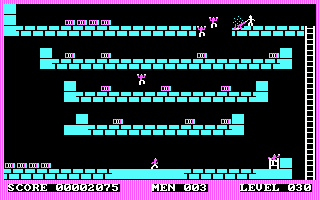
Lode Runner is a platformer, but with brains. You play as a character collecting gold bars scattered across the screen on a stage made of platforms and ladders. Enemies are chasing you. There's no gun at your disposal — instead, you dig holes in the floor, enemies fall into them, you jump over them. Once a hole fills in, the enemy is buried. Each screen is basically a spatial logic puzzle: which way, in what order, how to time your digging so you collect everything and survive.
The controls are simple, anyone can figure them out in two minutes. What you won't figure out in two minutes are the later levels — and that's where Lode Runner bares its teeth. The game originally contained a hundred screens, and the difficulty ramps up pretty uncompromisingly. No story, no cutscenes, no excuses. Either you solve it or you start over. What felt natural back then can be frustrating for an impatient player today — checkpoints are apparently a concept the creators never heard of.
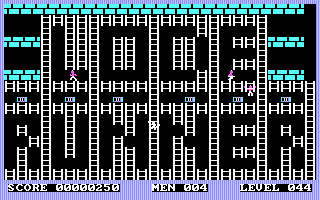
What Lode Runner brought to the table was a level editor. In 1983, that was something. Players built their own screens and shared them — years before user-generated content became a sales pitch. Visually, the game has obviously aged: CGA palette, character-based backgrounds, no animation to speak of. But the game loop works. That's actually what's most interesting about it — the digging and timing mechanic is so pure that nobody really improved it, they just gave it a fresh coat of graphical paint.
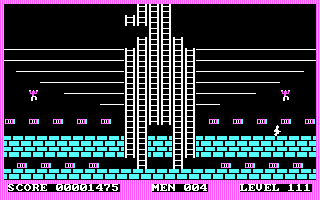
Today Lode Runner suits anyone who loves clean logic puzzles without modern bloat. Twenty minutes, thirty minutes, the player comes back. If you skipped it in the eighties, you've got a chance to settle the score now. And if you remember it — know that the frustration at level thirty is exactly as real as it always was.
 old
old


 ▶Tetris1985MS-DOS / PC
 ▶Boulder Dash1984MS-DOS / PC
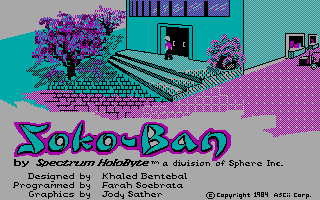 ▶Sokoban1984MS-DOS / PC
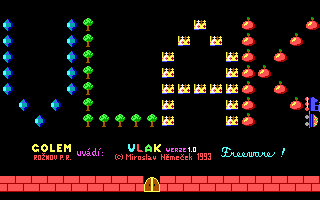 ▶Vlak1993MS-DOS / PC
 ▶Teenage Queen1988MS-DOS / PC


 ▶Chess1998Sega Mega Drive


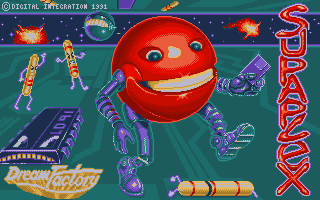 ▶Supaplex1991MS-DOS / PC


