Freddy Krueger had a specific talent for getting into places he wasn't welcome. Your dreams, your bedroom, and apparently your DOS prompt. A Nightmare on Elm Street from Westwood Studios, 1989, is the kind of licensed game that could have been a cash-in disaster — and yet it isn't, quite.
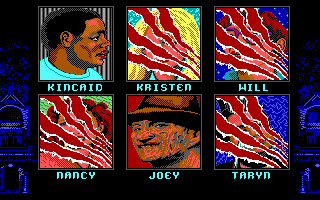
The game takes the film series as a loose framework rather than a strict adaptation. You move through environments pulled from the movies — suburban streets, basements, the kind of places that look worse at night — hunting down Freddy's bones to put him to rest for good. It's a side-scrolling action platformer, the sort of thing that filled shelves in the late eighties when every horror property with a recognizable face was getting the game treatment whether it deserved one or not.
What Westwood did reasonably well was atmosphere. The graphics are modest even by 1989 standards, but there's a grimness to the color palette that suits the source material. The sound on a Sound Blaster does its job — not memorable, but it doesn't undercut the tension either. The gameplay itself is straightforward: move, jump, fight, collect. The combat feels a bit like swinging your arm in a dark room and occasionally hitting something. Freddy shows up periodically, and those encounters have genuine urgency to them, mostly because surviving them requires more attention than the regular enemies do.
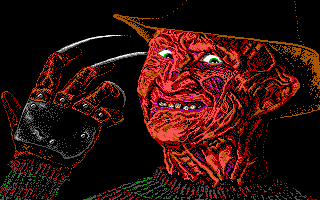
What aged poorly is the part that always ages poorly in games like this — the repetition. The level design doesn't expand much on its initial ideas, and by the midpoint you've seen most of what the game has to offer mechanically. It was a common problem in licensed platformers of the era, where the budget and schedule rarely allowed for the kind of depth that would justify the price tag. Westwood were still finding their voice in 1989; a few years later they'd be making Kyrandia and Eye of the Beholder, and the distance between this and those games is considerable.
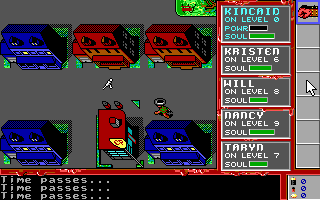
Still, for what it is — a licensed action game built quickly around a horror IP — it holds together better than most of its contemporaries. There's an actual sense of dread in the early stages that the developers clearly worked for rather than stumbled into. The bone-collecting mechanic gives you a concrete goal that structures the chaos, which is more than a lot of similar games managed. If you grew up with Freddy on VHS and you're curious how that translated to a monitor in 1989, this is worth an hour of your time. Run it in the browser, keep the lights low if you're feeling theatrical about it, and don't expect it to terrify you the way the films once did.
 old
old


 ▶Doom1993MS-DOS / PC
 ▶Tom & Jerry1990MS-DOS / PC


 ▶Ultimate Mortal Kombat 31996Super Nintendo
