Bu inceleme henüz çevrilmedi — orijinalini gösteriyoruz (English).
I remember it like it was yesterday: shareware floppy disks circulating around the classroom, everyone had a different part, and nobody knew if there was even a sequel. Jill of the Jungle was one of those games in 1992 that proved you could make platformers on DOS that didn't blush in front of consoles.
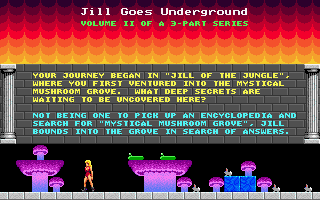
Jill Goes Underground is the second installment in the series from Epic MegaGames and a direct continuation of the original from the same year. Once again you control Jill, an Amazon warrior, who this time travels through underground levels full of enemies and traps instead of jungle. The setting shifts from tropical greenery to darker, rocky corridors — mushroom groves and cave environments give the game a somewhat different feel, even though the core gameplay loop stays the same.
The gameplay is pure action platforming: you jump, throw stars, dodge enemies, and hunt for keys and passages to the next levels. Jill can transform into a bird or a frog, which adds a thin layer of puzzles. Keyboard controls are precise enough not to frustrate, but it definitely doesn't feel like Super Mario — every jump is a conscious decision, not a reflex affair. The difficulty is old-school brutal in places: no checkpoints, tough enemies and traps that send you back to the start of the level on a single mistake.
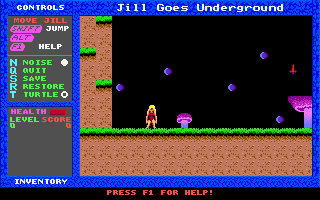
Epic MegaGames was riding the shareware wave hard back then, and Jill was one of their flagships — alongside Commander Keen from id Software and other DOS platformers of that era. The second installment brought better animation and new sprites, which you could really feel in 1992. The graphics use both EGA and VGA palettes, and in the highest mode it looks decent for its time. Sound depends on your hardware — if you had a Sound Blaster you heard music, if not, you played with PC speaker silence. Today the game has aged the way most DOS platformers have: the mechanics hold up, the pace holds up, but visually it's clearly a product of its era, and without nostalgia it won't blow you away.
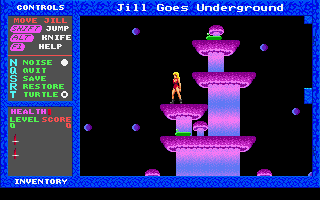
These days it'll appeal mainly to those who remember the original or want to understand what a PC platformer looked like back when it wasn't yet clear if DOS could even handle the genre. Playing it in a browser via DOSBox emulation is comfortable, the whole game is short, and beating it in an afternoon is no problem. If you haven't played the first installment, feel free to jump straight in here — nobody's going to hand you context, but you won't need it anyway.
 old
old


 ▶Doom1993MS-DOS / PCGrand Theft Auto (DMA Design)▶Grand Theft Auto (DMA Design)1997MS-DOS / PC


 ▶Contra1988MS-DOS / PC


 ▶Ultimate Mortal Kombat 31996Super Nintendo


