Bu inceleme henüz çevrilmedi — orijinalini gösteriyoruz (English).
You're standing in the center of a grid, surrounded. Enemies close in from every direction, fingers twitching on their triggers, and you've got maybe two seconds before the screen fills with fire from all angles at once. Gunrunner on the ZX Spectrum isn't trying to be clever—it's a pure arcade shoot-em-up where you navigate cramped rectangular arenas, grab ammunition, and return fire at anything that moves. The formula is simple. That's also why it works.

Christian F. Urquhart and Mike Smith built this in 1987 as a space invaders descendant with a twist: you're not in a bunker at the bottom of the screen, but locked in a maze of rooms with enemies spawning from all sides. Movement happens on a grid—you shuffle between tiles, rotating to face incoming threats while trying to keep moving so their bullets miss. Ammunition appears as pickups scattered around, and managing your supply becomes crucial when three or four enemies open fire simultaneously from different angles.
What makes it click is the tension. You're never safe because there's nowhere to hide. You can't circle-strafe or find cover; you just pivot, shoot, and step away while calculating which direction the next volley will come from. The Spectrum's attribute clash—those colored blocks that bleed into monochrome areas—actually helps here, giving each room a distinct blocky personality. Controls are responsive enough that mistakes feel like your fault, not the machine's lag.

The sprite work is minimal but readable. Enemies are small enough to see coming but not so tiny that you lose track in the chaos. The sound design is what you'd expect from 1987 Spectrum: harsh beeps that punctuate each shot, a thin musical loop that never overstays its welcome. After twenty minutes, you've heard everything the game has to offer audibly, but by then you're focused on survival anyway.
It hasn't aged in the sense that it still demands the same split-second decisions as it did in 1987. Difficulty curves upward predictably—more enemies, faster fire, tighter spaces. There's no narrative flab, no pretense. You shoot, you die, you restart. For anyone who grew up feeding coins into arcade cabinets or blasting through Spectrum cassettes back then, Gunrunner hits that sweet spot: immediate, brutal, and just smart enough to stay interesting across multiple runs.

If you're chasing that retro arcade fix and don't mind losing a few rounds to pattern learning, it's worth an afternoon in an emulator. Just don't expect mercy.
 old
old
 ▶Tanks1983ZX Spectrum
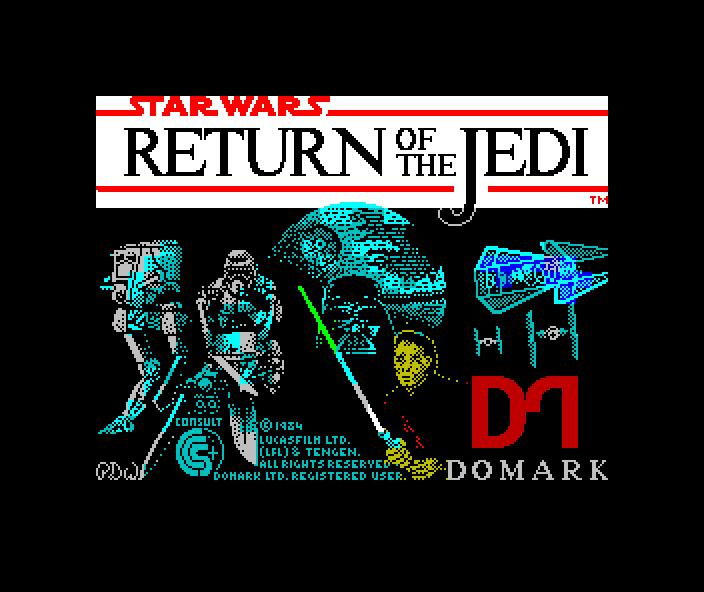 ▶Star Wars III - Return of the JediZX Spectrum
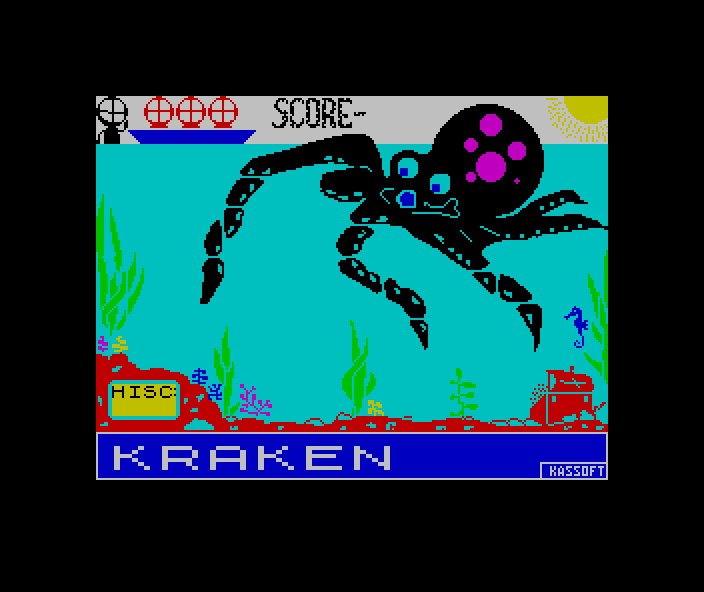 ▶KrakenZX Spectrum
 ▶3D Star Wars1983ZX Spectrum
 ▶The Way of the Exploding Fist1985ZX Spectrum
 ▶Babaliba1984ZX Spectrum
 ▶Silkworm1989ZX Spectrum
 ▶Starfighters1986ZX Spectrum


 ▶Doom1993MS-DOS / PC


