Bu inceleme henüz çevrilmedi — orijinalini gösteriyoruz (English).
Berlin, 1948. A city divided into four sectors, Soviet blockade on the horizon, and you're sitting at your keyboard with a text parser, trying to figure out what the game actually wants from you. That was an experience I didn't willingly sign up for back then — Berlin 1948 by Time Warp Software from 1989 was one of those titles you stumbled upon by accident rather than by design.
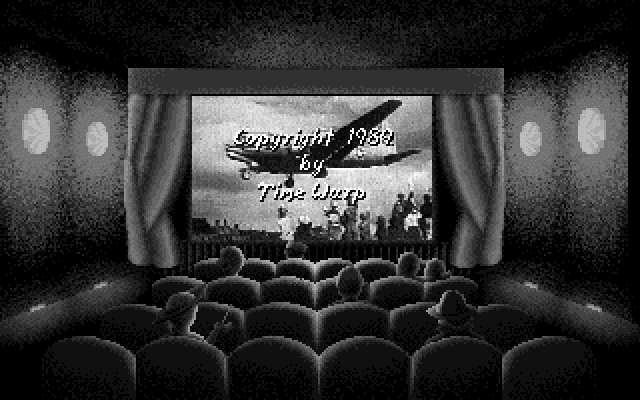
The game drops you into post-war Berlin at a time when tensions between East and West were just beginning to escalate. The genre is text adventure, or adventure with simple graphics — the exact visual packaging varied depending on which version you played. The setting of the early Cold War is promising on paper: espionage, a destroyed city, ideological pressure. Whether the game actually capitalized on this potential, or left it lying in the rubble like the Reichstag, is another question entirely.
Control works through a text parser typical for its era — you type commands, the game responds. The parser vocabulary at smaller developers like Time Warp Software was usually limited, so part of the frustration didn't come from puzzle complexity but from guessing the right verb. "OPEN DOOR" works, "USE DOOR" doesn't. You know the drill. The logic of some puzzles was period-appropriate — the kind of logic that made sense to the author at three in the morning but not to the player at noon.
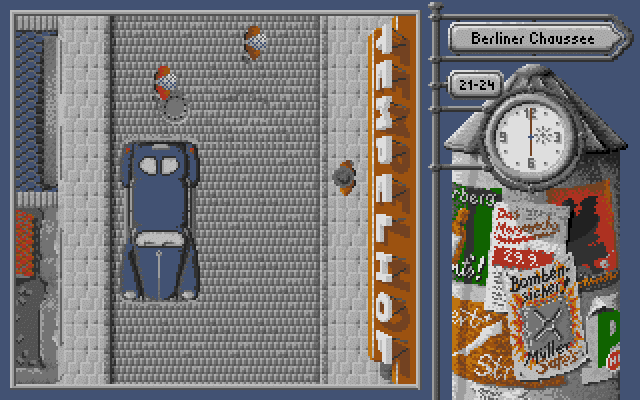
What sets Berlin 1948 apart from a generic text adventure is its theme. 1989, when the game was released, was a watershed moment in Berlin's history — the wall came down in November that year. I'm not sure if that was intentional or coincidence, but a game about a divided Berlin released at the moment when the real Berlin was reuniting has at least symbolic weight. On a technical level, it's a product of a small studio with none of Sierra On-Line's ambitions, so today it's approached more as a historical artifact than as a gem of interactive storytelling.
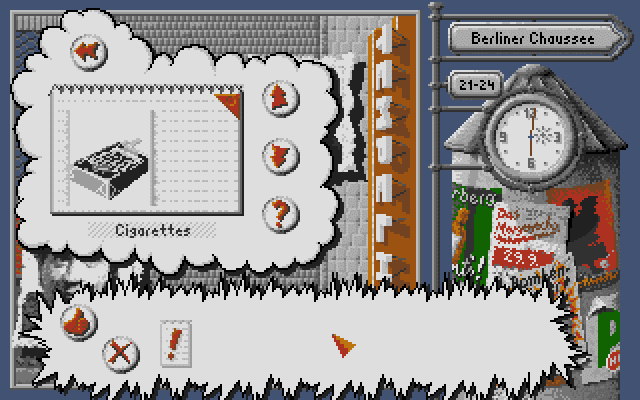
Who will Berlin 1948 appeal to today? Mainly those collecting experiences with obscure software from the eighties and who enjoy archaeological digs through genre history. The thematic backdrop of the Cold War and a divided city is still attractive — it's a shame the game uses it sparingly. If you don't mind the creaking of an old parser and the uncertainty about where exactly the game begins and where it just pretends to have content, you can check it out directly in your browser. Half an hour spent in post-war Berlin isn't worth much. Literally.
 old
old


