Esta análise ainda não foi traduzida — mostramos o original (English).
Year 1994, Windows 3.1, and a shooter that runs directly in it, not through a DOS prompt. That was almost a bold move back then — most respectable PC action games of the era weren't about to let go of DOS.
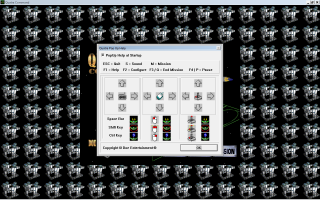
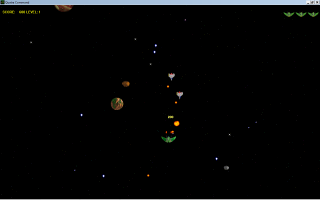
Quatra Command by DOE Entertainment is a vertical shoot 'em up set in space. It sounds generic because the game itself doesn't really venture beyond the genre's conventions. You fly, you shoot, you survive. Space is just a backdrop, not a story. But that's fine — Galaxian from 1979 didn't need a plot either.
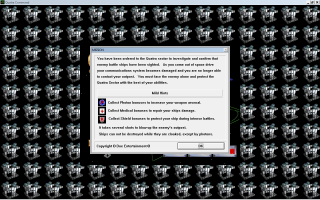
As a shoot 'em up, Quatra Command follows the genre's straightforward formula: you maneuver on screen, waves of enemies come, your main concern is not dying. The mechanics are economical, almost Spartan. No weapon branches, no elaborate power-ups that change gameplay — or if they're there, they bear the mark of that era when a two-person dev team just decided to make a game and call it done. The comparison to Kiloblaster that floats around abandonware sites fits: both games are compact, unadorned, and live or die by their pace and shooting feel.
What's interesting from today's perspective is precisely that Windows tie-in. Most action games back then ran under DOS and exploited direct hardware access for speed. Quatra Command went another route and stayed in a window with a title bar. In 1994 that was a compromise. Today it's actually an advantage — the game runs without issues in emulators and outside them, and that promise of XP/Vista compatibility from period descriptions became pretty much standard in DOSBox and modern browsers.
It aged exactly as expected. Graphically it's middling, the work of limited time and budget. Sound-wise it probably won't impress anyone who remembers what a quality Sound Blaster sounded like in a better DOS game. But shoot 'em ups aren't judged by polygons or orchestral soundtracks — they're judged by whether your hand automatically reaches for the spacebar one more time. And here Quatra Command holds up at least for an afternoon, especially if you have a sentimental attachment to the genre from your school days.
Playing it in a browser today makes sense mainly for two types of players: those who systematically went through nineties shoot 'em ups and have a gap in their collection, and those who want to remember how modest the entry costs into game development could be, and still produce something functional. Don't expect R-Type. You'll get an honest genre average from the time when Windows wasn't a gaming platform yet — just an unusual choice of battlefield.
 old
old


 ▶Doom1993MS-DOS / PC


 ▶Contra1988MS-DOS / PC


