이 리뷰는 아직 번역되지 않았습니다 — 원문(English)을 표시합니다.
Year 1984, CGA monitor, four colors and an unpleasantly shrill speaker. A baby hurtles out of a burning building window. You stand below with a blanket and know you have half a second to react.
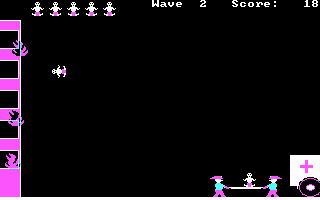
Bouncing Babies is an action game by Dave Baskin from 1984 for MS-DOS. The premise is so absurd that no studio today would have a chance of releasing it without a PR crisis: babies fall out of a burning house and you must catch them on a trampoline and bounce them into an ambulance. No story, no context. Just falling children and increasing tempo.
You control two firefighters, each standing at one end of the trampoline. You move them independently using the numeric keypad or arrow keys, the blanket stretches and sags between them according to their position. The goal is to set the bounce angle correctly so the baby reaches the ambulance parked at the edge of the screen. Sounds simple. It isn't. With each wave more children arrive, the pace accelerates, and you start making precisely the mistakes you swore you'd never make. Every caught and successfully bounced baby makes a sound that seemed cheerful then and is slightly unsettling today.
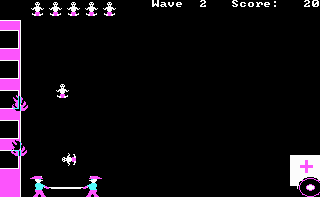
The game doesn't complain about its age because it doesn't really have one — this is the foundation of the reflex arcade genre, pure mechanics without flourish. What's aged is tolerance: today's player accustomed to tutorials and save states gets zero here and a quick death. No apology, no explanation. That was the standard then and in 1984 it was absolutely fine. Today it feels like a cold shower, but for a certain type of player it's exactly what they're looking for.
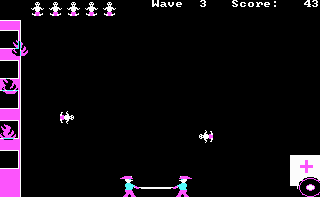
Bouncing Babies today suits those who want to understand what later arcades grew from, or simply need five minutes of pure stress without installation hassle. It runs flawlessly in a browser and the original playability remains untouched — which is simultaneously its greatest asset and greatest limitation. Twenty minutes with it is enough to know everything you need to know about it.
 old
old


 ▶Doom1993MS-DOS / PC


 ▶Contra1988MS-DOS / PC

 ▶Ultimate Mortal Kombat 31996Super Nintendo
