Αυτή η κριτική δεν έχει μεταφραστεί ακόμη — εμφανίζουμε το πρωτότυπο (English).
When Czech computer enthusiasts got their hands on something reminiscent of an old Chinese game in the late eighties, nobody really knew what to do with it. Mah Jongg Solitaire is exactly what the name promises — a PC version of a traditional tabletop puzzle that suddenly transforms into a computer game. Back then, anything with a foreign name was automatically cool.

The game works simply. The screen is filled with a sacred number of tiles bearing Chinese symbols, and your task is to find and remove pairs of identical pieces. Get rid of them all — that's victory. There's no story, no strategy, just your brain versus coordinates and memory. Because of the way the tiles are stacked into pyramids or other shapes, it's not just about chance — sometimes you need to flip the right tile or uncover it from beneath the others.
The controls are primitive, but that's precisely where the beauty lies. Cursor, click on a tile, click again. There are no elaborate sequences, no animations for the game to show off with. You simply have limited time, move after move, and tiles are revealed. The only sound you'll hear is the beep-beep-beep of successful matching. This very straightforwardness makes Mah Jongg Solitaire deceptively addictive — the player stares at the display, eyeing the next candidate for removal.
In the eighties and nineties, such a game was ideal for stealing a moment of computer time between work or school. Games of this type are still released today because they work. It's not about graphics, it's not about sound — it's about ritual. Those old MS-DOS versions especially had a specific charm: their simplicity was a feature, not a flaw.
The game was certainly playable in a browser or emulator, and anyway, Mah Jongg Solitaire belongs in that category of computer games that time hasn't destroyed. If you love quiet moments and you've got a taste for something that won't exhaust you but won't educate your mind either, this is your pick. It's a game grandmothers play on tablets, something a programmer might launch during a coding break. Nothing special, but effectively addictive.
 old
old


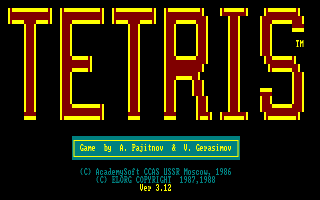 ▶Tetris1985MS-DOS / PC
 ▶Boulder Dash1984MS-DOS / PC
 ▶Teenage Queen1988MS-DOS / PC
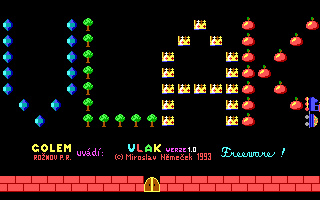 ▶Vlak1993MS-DOS / PC
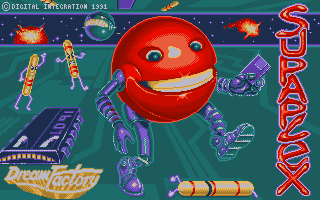 ▶Supaplex1991MS-DOS / PC

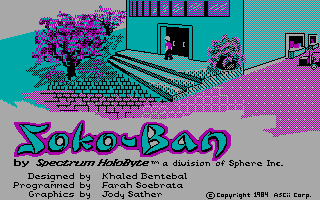 ▶Sokoban1984MS-DOS / PC

 ▶Boulder Dash III1986ZX Spectrum


 ▶Chess1998Sega Mega Drive