Denne anmeldelse er endnu ikke oversat — vi viser originalen (English).
"You are leaving — NOW!" That line from the opening briefing stuck with me not because it was genius, but because it perfectly captured the spirit of the entire game. Year 1997, Ukrainian studio Action Forms, and a genuine attempt to carve out a slice of the pie that Quake had just laid on the table.
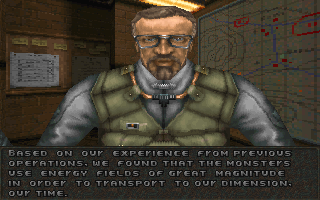
Chasm: The Rift is a first-person shooter where you play as a soldier sent to stop the so-called TimeStrikers — enemies capable of piercing through time and dimensions. The story is window dressing, not the backbone. You'll traverse environments from industrial halls through ancient temples to medieval locations, and this temporal mix is one of the few ideas the game attempts to set itself apart from the overwhelming competition of the time.
The gameplay sits firmly in the well-trodden tracks of the genre. You collect keys, hunt for switches, shoot things that move toward you. The engine handles sloped surfaces and dynamic lighting, which was still something to be proud of in the year of release. Enemies react visibly to hits — they stumble back, fall to their knees, body parts scatter across the ground. That was a selling point back then and partly works even today. Controls are exactly what you'd expect from a DOS madness of that era: mouse-look either on or off, and movement you'll get used to after a minute.
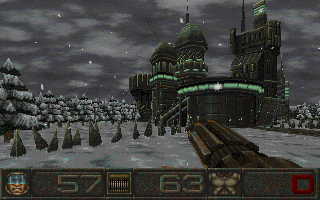
The problem lies elsewhere. Chasm came out a year after Quake and next to it always felt like a well-intentioned but second-rate affair. Level design is functional, rarely inspired. The music does its job, the sound effects are average. The game has no singular moment you'd pull out years later to show your friends as a memorable snippet. We remember it more as part of the tangle of clones released back then — yet it does stick out a bit from that tangle because at least visually it had ambition.
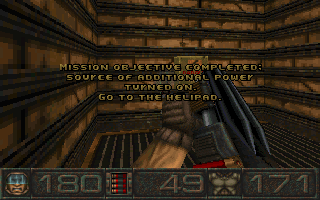
Today it'll appeal mainly to those wanting to explore the full spectrum of 3D action from the second half of the nineties, not just the canonical titles. It's shorter than Quake, less polished than Blood or Duke 3D, but fair and not brutally difficult. Fire it up in your browser via DOSBox-x or emulators on archive.org and you'll be running within ten minutes. It's an honest evening trip back to 1997 — not unforgettable, but definitely not wasted time.
 old
old


 ▶Doom1993MS-DOS / PC
 ▶Contra1988MS-DOS / PC


 ▶Ultimate Mortal Kombat 31996Super Nintendo