Bài đánh giá này chưa được dịch — chúng tôi hiển thị bản gốc (English).
Year 1991, Sierra On-Line, and a game that looked like a castle tour but turned out to be a three-hour battle with your own brain. I fired up Castle of Dr. Brain back then on the family 386 and discovered that this company, famous for adventures, could also make a puzzle game that won't let you catch your breath.
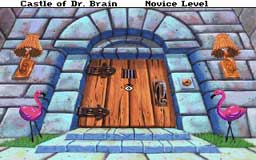
The whole concept is simple: you want to get inside the castle of the mysterious Dr. Brain and become his assistant. The castle is full of doors, mechanisms, and locks — and each one requires solving some kind of puzzle. No story to carry around, no dialogue. Just you and a series of problems that escalate from basic arithmetic and memory games to logic circuits, binary code, and spatial reasoning.
The controls are point-and-click, Sierra interface from the turn of the eighties and nineties — anyone familiar with the Quest series will feel right at home immediately. The puzzles are cleverly designed: three difficulty levels to choose from, so the game doesn't require you to master hexadecimal if you're not in the mood for it. Still, even the easiest version isn't a walk in the park. Nothing about it leaves you completely at ease, and that's exactly what you want from a logic game.
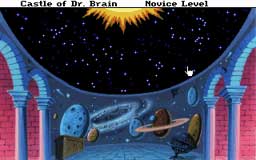
What makes Castle of Dr. Brain interesting even in retrospect is its genre integrity. Sierra didn't force a story where it wasn't needed, and instead put together a genuinely diverse collection of puzzles — mastermind, tangram, programming basics, mazes. In 1991, that was surprisingly noble for an educational game. It has aged well where it matters: the puzzles work the same way and the EGA/VGA graphics don't hurt anyone's eyes. Worse is navigating the castle, which at times feels unnecessarily click-heavy and disrupts the pace.
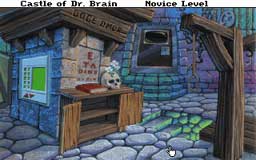
Today, anyone who loves puzzle games without modern hand-holding will enjoy it. There's no hint system around every corner, no chatty tutorial. You get the castle, you get the puzzles, and the rest is up to you. Fire it up in your browser via DOSBox without any trouble, and those few hours it takes are hours spent thinking — not clicking into the void.
 old
old

 ▶Vlak1993MS-DOS / PC
 ▶Tetris1985MS-DOS / PC


 ▶Sokoban1984MS-DOS / PC
 ▶Boulder Dash1984MS-DOS / PC

 ▶Supaplex1991MS-DOS / PC


 ▶Where in the World is Carmen Sandiego1991MS-DOS / PC


