Цей огляд ще не перекладено — показуємо оригінал (English).
When someone picks up a joystick thinking they're going to build a roller coaster, they're in for some seductive boredom. Coaster from 1993 isn't a game you'd play for fun — it's an industrial simulator wrapped in retail packaging, something you'd take home and tinker with at your desk.

It's a straightforward top-down rail construction system. From keyboard functions or menus, you pick your design elements — slope, curve, Loop, Corkscrew. You gradually build the track using basic geometric components. Then the cart takes its journey and the simulator calculates structural stress, velocity at various points, and derailment risk. It's all very straightforward and lazy — no 3D rendering, no graphics on the level of Roller Coaster Tycoon, which would arrive four years later.
The controls are primitive, but they work. Text menus, numerical data, no visual feedback worth noticing. Coaster makes do with what it has — pure physics calculations. You see the result of the cart on the track as a simple line. There's nothing catastrophically bad about it — it's just conservative, without polish, without anything to grab your heart.

Today's players might remember Coaster partly because roller coasters are a timeless hit, and partly because it existed in an era when simulators were everything. It's not a game you'd particularly remember, but it existed, had its purpose, and could've pleased people who loved physics and construction. It aged the way all purely numerical simulators do — it became pointless the moment games arrived that did the same thing with graphics.
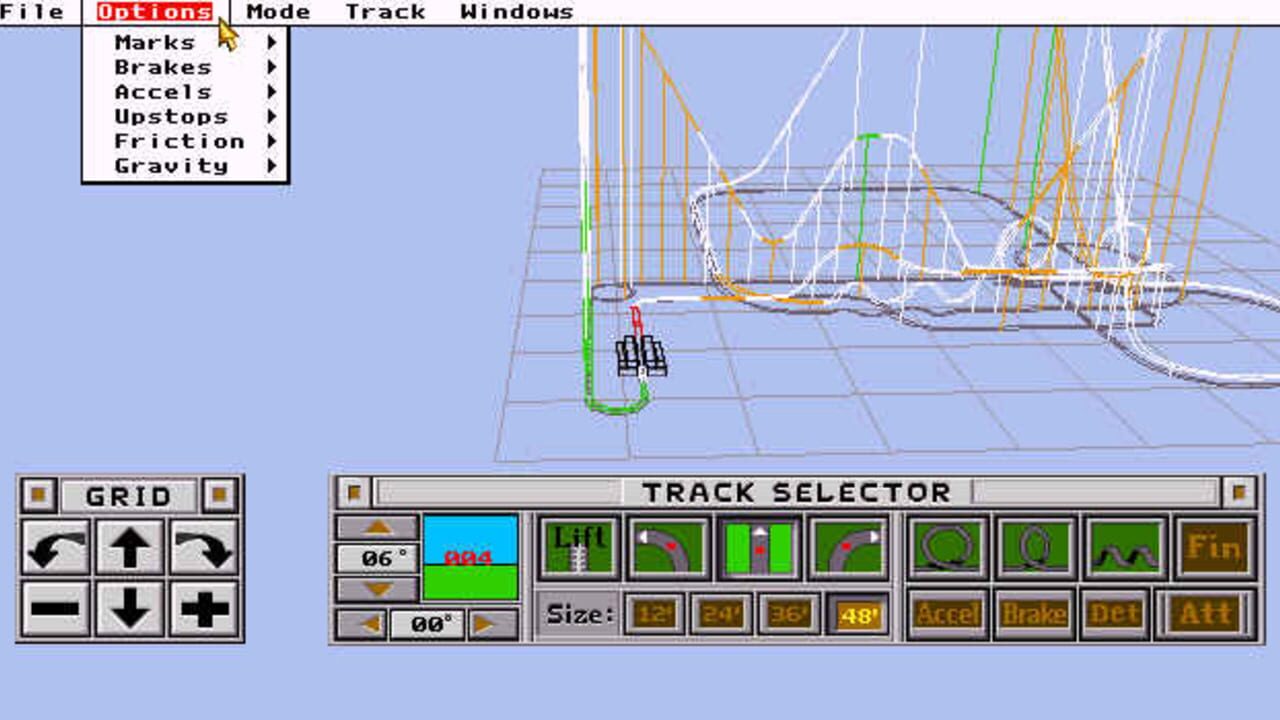
Today you'd try it mostly out of nostalgia. It doesn't even pretend to be fun — more like a calculator on paper. But that's exactly what makes it appealing — it's pure mechanics without the fluff. If someone wants to pick up a joystick and think purely mathematically about rail dimensions, Coaster still exists in the archives.
 old


 ▶Pinball Fantasies1992MS-DOS / PC
 ▶Windows 95 in the BrowserMS-DOS / PC
 ▶Free Croatia (DOS game)MS-DOS / PC


 ▶NHL '941993MS-DOS / PC
