Year 1992, I was thirteen, and on the desk stood a 486 with eight megabytes of RAM—plenty for most things back then. The Four Crystals of Trazere I first saw on a burned copy from a classmate—a diskette without a case, labeled with a marker. I loaded the game, started it up, and didn't leave for the next few hours.
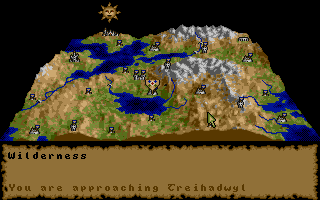
Mindscape released this RPG for DOS during a time when the genre was experiencing solid growth on PC. The setting is classically fantasy—the dark land of Trazere, some ancient evil, chaos across nations, and the player in the middle of it all with a band of adventurers. Nothing revolutionary on paper. Four crystals to find, plenty of enemies ready to talk to you with their swords. World-saving in its most basic form.
The game works as a dungeon crawler with turn-based combat and fairly solid party management. You create a group of characters, distribute stats, plan your lineup. Battles aren't action-based—you sit, think, click. Or click and then think about why you're dead. Exploration is first-person, movement grid-by-grid, walls all around. If Eye of the Beholder sat well with you, you'll feel right at home here. Sound Blaster audio worked, graphics were acceptable for 1992—not dazzling, but functional.
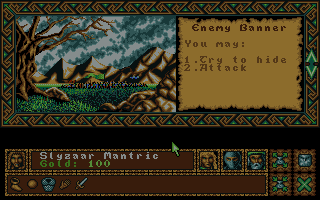
What set the game apart back then was atmosphere. Mindscape layered Trazere with plenty of darkness, and that sense of threat was genuinely there—not from cutscenes or dialogue, but from how the game behaved. Enemies mutated by unknown forces, an environment that offered no comfort. It wasn't cheerful fantasy. On the other hand, the game aged in a way that's harder to forgive today—the interface is clunky, navigating dungeons demands either a sharp memory or pencil and paper, and the documentation you once needed to survive is no longer always at hand.
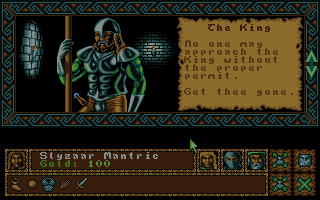
Today you can play it in a browser or via DOSBox if you have an affinity for nineties dungeon crawlers and don't mind a game that won't hold your hand. It's a piece of genre history, not its peak—but it has character and an unmistakable period charm. If you know Dungeon Master or the aforementioned Eye of the Beholder and want to see how similar games were made outside the mainstream, here's your answer.
 old
old


 ▶Dungeon Master1989MS-DOS / PC


 ▶Amberstar1992MS-DOS / PC
 ▶Ancient Domains of Mystery1994MS-DOS / PC
 ▶Autoduel1988Commodore 64


