Den här recensionen är inte översatt än — vi visar originalet (English).
1983. Tolkien's book sits on the shelf, I'm twelve years old, and there's a text prompt in front of me waiting to see what I'll type. GO NORTH. TAKE SWORD. And then Gollum walks off with the ring because I forgot to take it from him earlier, and I start over. The Hobbit managed to frustrate me in a way modern games can't even achieve.
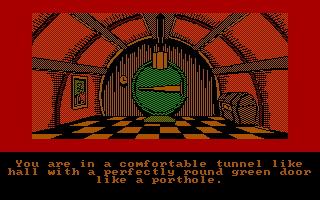
The Hobbit from Australian studio Beam Software is a text adventure loosely based on Tolkien's first book. Released in 1983, originally on 8-bit computers, it soon arrived on PC as well. The goal matches the book — Bilbo, dwarves, dragon, treasure. But getting there is something else entirely.
The game used its own parser that could handle multi-word commands — things like TELL GANDALF TO FOLLOW ME or GIVE RING TO BILBO were almost magic in 1983. Characters moved around the world independently of you, with their own agency. Thorin would sit down and sing about gold exactly when you needed him elsewhere. That was intentional, but an intention that could drive you mad. The world didn't wait. Enemies could kill you while you sat thinking about your next command. Real-time adventure — in 1983 either a progressive idea or sadism. Depends on the day.
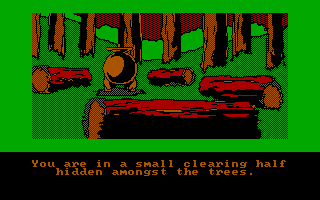
What The Hobbit brought was the realization that a text adventure could be a living system, not just a sequence of puzzles. Interactive characters, a relatively open world, a parser that went beyond simple verb-noun combinations. Games like Infocom were pushing the genre too, but this had its own character — and its own frustration. Many puzzles depend on timing and where certain characters happen to be. The documentation and hints won't tell you everything. A lot of solutions simply had to reveal themselves through trial and error, or word-of-mouth from a school friend who'd read about it somewhere. The nostalgia is enormous. Playability today? Call for caution.
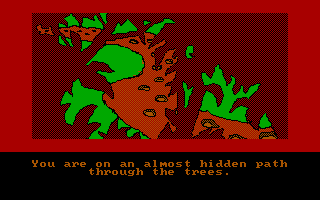
Nowadays The Hobbit is played mainly by two types of people. Those who remember it and want to see if it's really as hard as they think — it is. And then historically-minded curiosity seekers interested in where the roots of interactive NPCs and ambitious parsers came from. It's available in browsers through various emulation archives, so the barrier to entry is zero. The barrier to exit — patience — is another matter.
 old
old


 ▶Amazing Spider-Man1989MS-DOS / PC


