Этот обзор ещё не переведён — показываем оригинал (English).
Year 1989, with just a few megabytes of free disk space, and I'm spending hours in a text-based rock stardom simulation instead of studying for geography. Rockstar by Wizard Games was exactly the type of game that looked humble but had you hooked before you knew it.
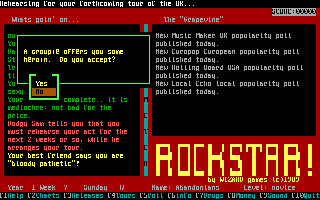
The goal is to take your band from local gigs all the way to the top of the global charts. You start small, playing in local clubs, gradually working your way up to bigger cities, until you find yourself in America or Europe. Along the way, you write songs, record singles and albums, and decide whether to sign with a major label or stay independent. Every choice has its price and its consequences — that's what made the game engaging.
Gameplay revolves around resource management and decision-making: when to release an album, when to hit the road, how to handle money and popularity. The interface is text-based, keyboard controls, no graphical bells and whistles. The magic was that despite this austerity, you genuinely felt like a band manager watching your group either rise or slowly fall apart because of bad decisions. Throwing a party with fans might seem like a detail, but even these little touches built the atmosphere of a world where fame is a fragile thing.
What aged worst is the lack of clarity and absence of tutorials — in 1989, it was simply expected that you'd read the manual, and if you didn't have it, it took a while to figure out what actually worked and what didn't. Today it requires a bit of patience. On the other hand, this mechanical austerity is also its greatest strength — nothing holds your hand, so every success feels genuinely earned.
Today, Rockstar appeals mainly to those who love management sims from the era before the genre got buried under tutorials and hand-holding indicators. It's a historical artifact — proof that you could tell an engaging game loop with minimal pixels. If you're willing to spend twenty minutes understanding the rules, the reward comes in the form of nostalgic comfort that modern games rarely capture.
 old


 ▶Sid Meier's Civilization1991MS-DOS / PC


 ▶Chess1998Sega Mega Drive


