Denne anmeldelsen er ikke oversatt ennå — vi viser originalen (English).
You wake up on a beach. You don't know who you are. A palm tree nearby, the ocean beyond, and absolute emptiness in your head. Mindshadow throws you into the deep end right away — and for a text adventure from the then-young Interplay in 1984, that was quite a bold opening.
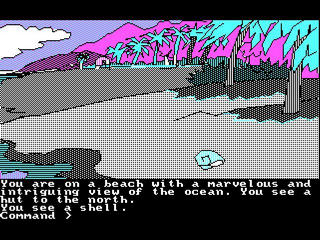
It's a text adventure with amnesia as its central theme. The goal is straightforward: figure out who you are, how you ended up on this island, and what actually happened. The game gradually takes you through various locations, from tropical shores to more civilized settings, slowly piecing the story together. The spy thriller genre isn't just window dressing here — amnesia as a game mechanic for uncovering the plot was a fresh idea for its time.
Control is purely text-based, with an English parser, and it follows the same rules as most games of that era: you need to hit the right words, or the computer will coolly tell you it doesn't understand. Interplay tuned their parser better than many competitors, though, so the frustration from dead-end responses is somewhat less painful than, say, early Sierra adventures. Puzzle logic is mostly fair, occasionally a bit arcade-y — the game switches to simpler action sequences now and then, which slightly hurts the text adventure pace.
I remember Mindshadow as a game that could evoke a genuine sense of disorientation — and that's a compliment. The graphic companion images, present in some versions, were above standard for 1984. Today the game ages the way typical for the whole genre: slow letter-by-letter text, the need to guess the parser, and no hints — after twenty minutes, it either captures you completely or turns you away for good. No middle ground exists.
These days Mindshadow works for anyone who loves early adventures and doesn't mind that fun sometimes comes down to figuring out how to ask the right question, not what to do. It's a piece from when Interplay was still finding its voice — yet you can already see it will find one. If English text doesn't bother you and you've got some archival patience, it's worth remembering how it all started.
 old
old


 ▶Doom1993MS-DOS / PC


 ▶Ultimate Mortal Kombat 31996Super Nintendo
 ▶Contra1988MS-DOS / PC