Denne anmeldelsen er ikke oversatt ennå — vi viser originalen (English).
When you start Apachacha, you're met with silence. There's no sound menu, no music. Just a sequence of screens with a minimalist look that gradually dampens your enthusiasm. It's like watching something that aspired to be fun, but somewhere in development, someone threw in the towel.

Apachacha is a logic puzzle from an era when such things functioned as computer meditation. On a nineties PC, it offers you puzzles built on a simple principle: assembling pieces together so they form an object or pattern. The controls are primitive, but that's not a flaw—it's the very essence of the game. You move a cursor around, and with minimal visual feedback, the game tells you what's possible.
Playing is repetitive in its purest form. There's no story, no challenge, no proper sense of satisfaction. You solve one puzzle, then another, they all look the same, until you realize the difference between individual levels is virtually zero. The game isn't technically bad—it's simply… an absence. Absence of ambition, absence of design, absence of awareness for why a player should be motivated to continue.
Apachacha came into the world at a time when indie developers didn't yet have online sharing and when experimental software fell into home computers like bricks into a river. Regardless of who created it, it remained the blandest unclaimed brick. It's not evil, it's not truly terrible, but it's so mediocre and hollow that you forget about it easily.
If you're curious what the lowest common denominator of computer entertainment looked like in the early nineties, Apachacha is here. For anyone else, it's a well with no water. Run it if you want to know what boredom looks like in its purest form.
 old
old


 ▶Teenage Queen1988MS-DOS / PC
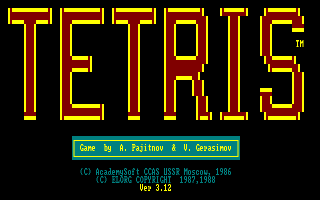 ▶Tetris1985MS-DOS / PC

 ▶Boulder Dash1984MS-DOS / PC
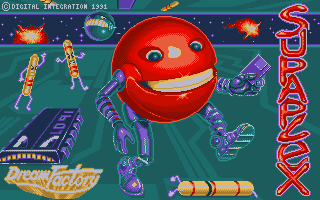 ▶Supaplex1991MS-DOS / PC

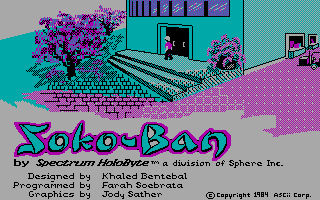 ▶Sokoban1984MS-DOS / PC


 ▶Boulder Dash III1986ZX Spectrum


 ▶Chess1998Sega Mega Drive