Denne anmeldelse er endnu ikke oversat — vi viser originalen (English).
Humans 3 solves the same problem as every logic game from the nineties — how to entertain players with puzzles when the graphics look like a paper monster. The answer is simple: if you design the puzzles yourself, you won't miss the graphics at all.

It's a combination of platformer and logic puzzles. I play as a humanoid character traversing a world called Lost in Time — an environment where physics isn't always earthly and the goal changes every time. One moment I'm collecting things, the next I need to push something, block it, or set it on fire to open the way forward. On paper, nothing revolutionary, but in practice it works like someone took Lemmings, shrunk it down to a single character, and gave it a brain.
The controls are simple — movement, jump, interaction. The beauty lies in the fact that the game never tells you exactly what to do. You find yourself in a room and have to read it like a clue. This thing here is lying awkwardly, over there a rope is missing, here's a hole. Solving it means experimenting, failing, occasionally experiencing a quiet aha-moment. It's not frustrating, it's more like meditation suited to the pace of those times.
Humans 3 survives because it doesn't rely on graphics or sound — back then everyone focused on those unnecessarily. It relies on an idea you'll take with you. The game doesn't work by itself; you have to partly create it yourself. That's something today's machine-generated puzzle games can't even look in the eye.

Today you'll find it in some retro game collections or internet archives. The screen is in those 320×200 pixels, the sound is approximately one beep per minute, and yet — or precisely because of that — you want to solve something under your fingers. It's not for everyone. But if you enjoy spending time staring at a scene and thinking about what should happen next, Humans 3 is your friend.
 old
old

 ▶Super Solvers Gizmos and Gadgets1993MS-DOS / PC


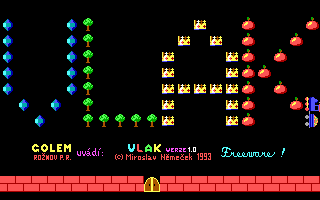 ▶Vlak1993MS-DOS / PC


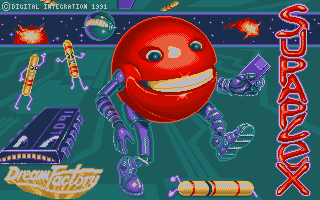 ▶Supaplex1991MS-DOS / PC
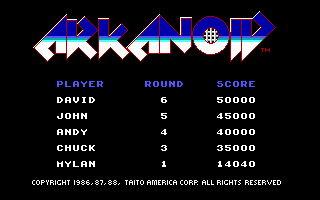 ▶Arkanoid1988MS-DOS / PC
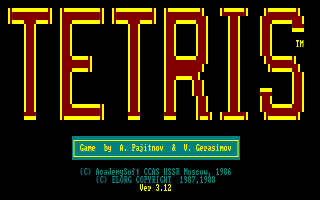 ▶Tetris1985MS-DOS / PC
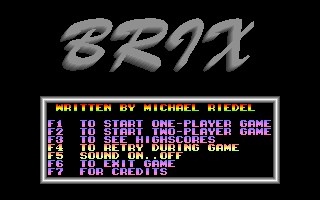 ▶Brix1991MS-DOS / PC