Hindi pa naisasalin ang review na ito — ipinapakita ang orihinal (English).
Year 1993, a CRT monitor barely managing to render those polygons, and I'm sitting in front of my keyboard with a laid-out keymap. TFX from the British studio Digital Image Design arrived on a disk at our place sometime in autumn, and suddenly I was piloting machines that didn't even properly exist yet.
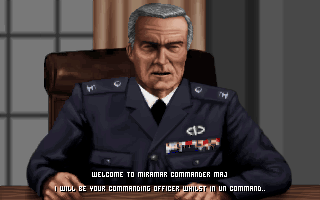
TFX — Tactical Fighter eXperiment — was a flight simulator that bet on the future of that era. It put three machines in the cockpit: the classified F-117A Nighthawk, the then-still-theoretical Eurofighter 2000, and the Lockheed F-22. Each had a different character, different weapon options, and a different role in missions. The game took place in crisis zones inspired by contemporary conflicts — after the fall of the Iron Curtain, the world was suddenly full of local wars, and the gaming industry quickly picked up on that.
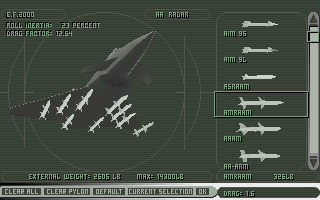
Gameplay relied on an interesting compromise. TFX offered both an arcade mode for those who just wanted to fly and shoot, and a more demanding tactical approach with mission planning, ammunition selection, and more realistic aircraft behavior. You could customize your loadout before missions — this option wasn't standard back then. Controls were accessible without a joystick, but with one they really came into their own. Graphically, the game used solid 3D polygons for 1993 standards, though the sky looked more like painted cardboard than an actual atmosphere.
What set TFX apart from the competition was its emphasis on tactics alongside action. It wasn't Falcon 4.0, so simulation enthusiasts sometimes overlooked it as too accessible. It wasn't a pure arcade shooter either. It sat right in the middle — and that's a position that scored solid reviews in 1993, but didn't leave as deep an impression on players' hearts as harder sims or pure action games. Today, the dated interior graphics and certain mission stiffness without narrative flow are the weakest points.

Today TFX suits mainly those who want to sample early-90s flight simulation without reading a four-hundred-page manual. Or those who remember what the future of aviation looked like back then — and want to experience it again, this time in a browser, without installation and without hunting for a boot disk. A thirty-year-old game about machines of that era's future has its own special charm. Nostalgia is free.
 old
old


 ▶Pinball Fantasies1992MS-DOS / PC


