Этот обзор ещё не переведён — показываем оригинал (English).
I remember that feeling when I first sat down in the Thunderhawk cockpit. It was hot outside, the monitor glowed in the darkness of the room, and the sound of rotors echoed from the Sound Blaster speaker. 1991, Core Design — the studio that would make a name for itself with Lara Croft a few years later — tried something different here: a helicopter title that leaned neither purely toward simulation nor purely toward arcade action.
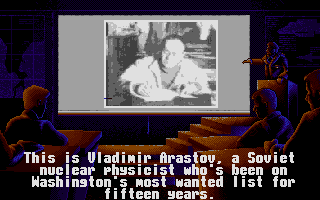
Thunderhawk AH-73M is aerial action with simulation elements, set in fictional military conflicts around the world. You sit at the controls of a combat helicopter and carry out offensive and defensive missions — destroying ground targets, protecting friendly units, escorting convoys. Missions vary, environments change. Nothing particularly original on paper, but on PC in 1991 it was a solid package.
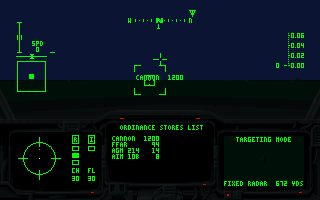
The controls are deliberately streamlined. Thunderhawk never pretended to be DCS for the nineties — flight physics are simplified, enemies don't shoot at you as aggressively as in more demanding simulators. The result is accessible, but not without teeth. Missions have momentum, ammunition is limited, navigation demands attention. Anyone expecting to just fly in and sweep everything aside soon discovered that the helicopter isn't an invincible beast with infinite endurance. Copying maps from the game onto paper and calculating fuel consumption was standard practice back then.
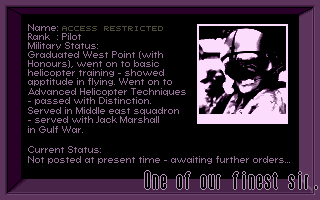
The game even had copy protection in the form of security questions from the manual — a small detail that today brings more nostalgic smiles than frustration, since about five hundred photocopies of the manual were circulating around the Czech Republic. Graphically, Thunderhawk took a passable route — vector environments, colorful backgrounds, a few sprites for enemies. In the context of 1991, it worked. Today it looks like a first attempt from a student club, but back then it ran smoothly on a 486, and that was an argument.
What aged poorly? Mainly repetitiveness. Missions start to resemble each other more than is healthy. There's a lack of strong narrative anchoring, enemies lack variety, and the graphics don't do much to hide the absence of content. Core Design was still finding its voice at this point — and you don't hear much of it here.
Still, Thunderhawk sits well today with anyone who wants a quick taste of helicopter action without spending hours reading flight manuals. You can play through it in a browser in an afternoon, reminisce about what arcade simulation looked like before the genre split into two irreconcilable camps. It's not a gem you absolutely need to uncover. But it's an honest period artifact — and that has value.
 old


 ▶Pinball Fantasies1992MS-DOS / PC
 ▶Free Croatia (DOS game)MS-DOS / PC
 ▶Windows 95 in the BrowserMS-DOS / PC


