Этот обзор ещё не переведён — показываем оригинал (English).
Year 1990, the monitor glows in the darkness, and I'm staring at a map of ancient China divided into provinces. No animations, no tutorials, just tables of numbers and decisions that will play out five turns later. Romance of the Three Kingdoms II by KOEI — a game that didn't coddle the player, but treated them as an equal partner from the start.
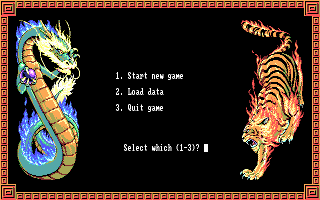
The game draws from the famous Chinese novel about the collapse of the Han dynasty and the war of the three kingdoms at the turn of the 2nd and 3rd centuries. But it's not a narrative — it's cold, calculated strategy. You pick one of twelve rulers, each with a different starting position, and attempt to unite fragmented China under your banner. Liu Bei, Cao Cao, Sun Quan — or whoever else you put in the saddle. KOEI gave you choice, not a linear story.
Each turn you manage provinces, hire generals, trade, build armies, and eventually wage war. The interface is purely text and table-based, accessing functions through menu after menu. By today's standards it looks like a tax return with a sword in the logo. But beneath that austere facade lies a system of surprising depth — troop morale, general loyalty, natural disasters, diplomacy, supply lines. Every action has side effects, and the turn when you think you've got it won, might be exactly when someone stabs you in the back.
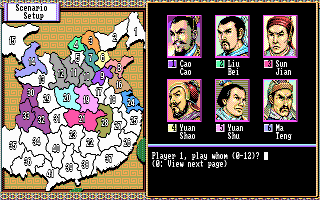
What KOEI brought with this series was a genre that barely existed in the West in 1990 — complex historical builder strategy with turn-based gameplay and emphasis on state management, not just moving pieces across a map. Civilization wouldn't arrive for another year. Romance of the Three Kingdoms II played its own game and was alone in it. Today it's aged exactly where you'd expect: the controls are clunky, feedback minimal, and the learning curve steep as Qilin's staircase. Anyone expecting modern UX will walk away in five minutes.
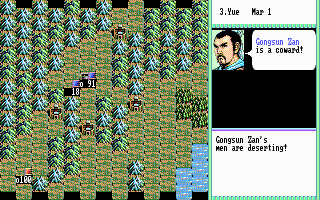
Who would enjoy it today? Players with patience and interest in old-school historical strategy — or those who want to see where the Romance of the Three Kingdoms series began before it spawned dozens of sequels. You can play it in your browser without installing DOSBox, and even just an hour with it will show you why KOEI had no competition in this genre in the nineties. It's not nostalgia. It's respect for a job well done.
 old
old


 ▶Teenage Queen1988MS-DOS / PC


 ▶Chess1998Sega Mega Drive


