Этот обзор ещё не переведён — показываем оригинал (English).
Alan '96 — a name that sounds like a taxi dispatcher made up five minutes before deadline. You have no idea what this game actually is when you look at it. Black screen, a few lines of text, it looks more like a programming course exercise than a game. But that's precisely what makes it interesting.
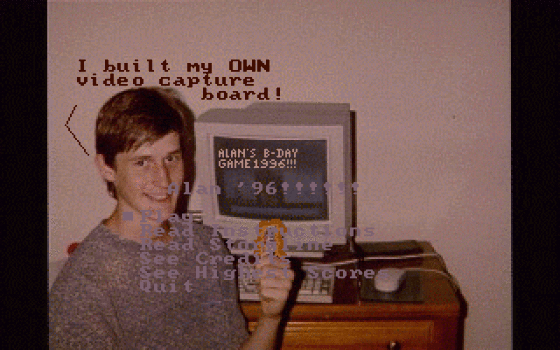
Here you get pure text adventure from the days when ASCII art was the standard and nobody complained. You wander through environments, read descriptions, type commands — and then wait a long time to see if anything actually happens. Alan '96 is a game that people will play if they want to pretend they're playing a game. Everyone else will just stare at the monitor waiting for inspiration.
Mechanically, it's minimalist to the point of coldness — you type a word, the system processes it or doesn't. No dropdown menus, no icons, no sarcastic commentary like you'd find in the genre's later evolution. You're alone with your command input and the hope that your intellect aligns even slightly with the creator's vision. Often it doesn't.
Back in the nineties, this kind of thing still existed on BBS boards or as some enthusiast's home project, someone who thought they could steer games closer to literature. Alan '96 is much the same — it's a piece of nostalgic sensualism, but without exclamation marks and without a product anyone made money from. That's precisely why it became a time capsule. A small group of people played it, people who liked thought to replace graphics.
Today you'll play it in a DOSBox emulator as a curiosity — proof that twenty years ago, developers existed who weren't afraid that boredom could be a feature. You'll experience it as a moment in time when computers served imagination rather than rendering billions of pixels. Unfun? Yes. Overwrought? Also yes. But somehow it gets to you.
 old


 ▶Muppet Treasure Island1996MS-DOS / PC


 ▶Bubble Bobble - The Adventure1993ZX Spectrum
