Deze recensie is nog niet vertaald — we tonen het origineel (English).
Horace doesn't just want the food—he needs it, the way a man needs air. There's no plot, no story, just a creature driven by pure hunger through a maze on the Spectrum's cramped screen, and that's enough. Hungry Horace is what happens when you strip Pac-Man down to its skeleton, bolt it onto the ZX's limited hardware, and hope something clicks. It does, mostly.

The premise is straightforward arcade brutality. You guide Horace through a single-screen labyrinth dotted with pellets, chomping them like your life depends on it. Enemies patrol the corridors—call them guards, ghosts, whatever you want—and they're relentless. Eat enough pellets, clear the screen, move to the next one. Repeat until you slip up. There's a power-up somewhere, something that flips the script for a few seconds, but it's the hunger that drives the whole thing forward, not strategy or depth.
The controls are bare-bones; Spectrum joystick users got the stiff, grid-locked movement that defines early 80s arcade ports. Horace snaps from square to square with all the grace of a chess piece, which sounds clunky until you realize it's the only honest way to translate this kind of game to the platform. The collision detection is unforgiving. One pixel wrong and you're done. There's no mercy, no invincibility window—just death and the familiar beep of failure through the speaker.
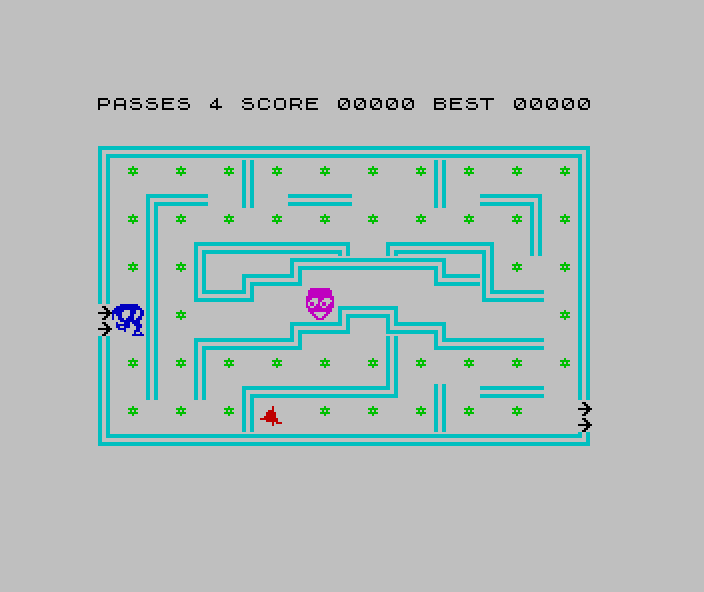
What made Hungry Horace memorable wasn't innovation; it was the sheer efficiency of the idea. This was 1983, early in the Spectrum's life, when ports of arcade standards were still exciting rather than expected. Horace wasn't better than the arcade original—it couldn't be—but it brought something hungry into the home. The visuals are basic, chunky even by Spectrum standards, and the sound is the system doing what it does: beeps, chirps, a tinny rendition of urgency. But there's a rawness to it that feels right for the machine.

Today it's a curiosity, a relic of when porting meant compromise and compromise meant character. If you go back now, you're not looking for polish—you're looking for the ghost of what arcade gaming felt like when it still had something to prove on home computers. Hungry Horace isn't a classic; it's a footnote. But it's a footnote worth revisiting if you remember when footnotes mattered.
 old


 ▶Pacman's Revenge1987ZX Spectrum
 ▶Bongo1984ZX Spectrum
 ▶Down to Earth1987ZX Spectrum
 ▶Krazy Kong1984ZX Spectrum

 ▶Buggy Boy - East TrackZX Spectrum
 ▶The Chinese Juggler1984ZX Spectrum
 ▶Manic Mower1992ZX Spectrum

 ▶Sideral War1990ZX Spectrum
 ▶Capman1983ZX Spectrum


 ▶The Simpsons Arcade Game1991MS-DOS / PC


 ▶Dangerous Dave1990MS-DOS / PC


 ▶NieuwMravenečci2026Webová hra

 ▶Pinball Fantasies1992MS-DOS / PC