이 리뷰는 아직 번역되지 않았습니다 — 원문(English)을 표시합니다.
I remember that feeling when the camera first tilted over the edge of an aerial bridge and the car hung in the air for a moment before dropping down. On a monitor with resolution that wouldn't raise an eyebrow today, it looked like real racing back then.
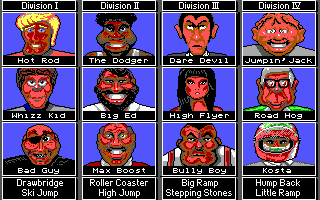
Stunt Car Racer from Geoff Crammond Games — yes, the design came from that very person — came out in 1989 and arrived on PC as a port from the original Amiga. Genre-wise it's a racing game, but not a traditional one. Forget asphalt circuits and grandstand backdrops. Here you drive on elevated wooden tracks suspended in the air, full of jumps, steep hills, and sections where the wrong speed means a simple fall into the void. The whole idea rests on one thing: turning racing into a physically controlled adventure, not just a test of reflexes.
The game is divided into four leagues. In each you race against two opponents, winning a league means moving up. There are only a few tracks per league — and that's a real problem. Soon you know them by heart and racing becomes more repetition than discovery. But the driving model holds your attention: the car responds to terrain, the suspension leans, you land badly after a big jump and the chassis takes the hit. Damage is visible and felt — you pass a checkpoint with a broken car, or you don't pass it at all. Keyboard controls are acceptable, but whoever had a joystick was clearly in a different league.
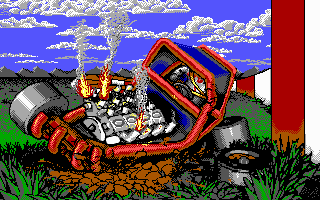
What Stunt Car Racer brought was a truly different cockpit view back then. Not a panoramic vista, but a low-mounted camera that gave you a sense of speed and height at the same time. In 1989 that was remarkable on PC. Today the graphics naturally look primitive, but the core game loop — keeping the car on the track, not smashing it up, posting a better time than your rival — still works. It's just a question of whether you mind getting through all the content faster than would be healthy.
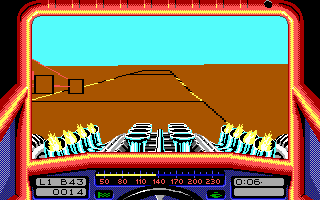
Today anyone can play Stunt Car Racer in a browser if they want to see how racing could be approached differently from how most titles handled it back then. Clean, straightforward mechanics, no tutorials, no unlocking content after a hundred hours. It'll appeal to nostalgics who remember when a game didn't need forty pieces of content — one good idea executed well was enough. Shame about those tracks though. A few more wouldn't have hurt anyone.
 old
old


 ▶Test Drive1987MS-DOS / PC


 ▶Pitstop II1984MS-DOS / PC


 ▶F11993Sega Mega Drive


