Ulasan ini belum diterjemahkan — kami menampilkan versi asli (English).
There were games where I'd sit at the keyboard for two hours and then get up in frustration. Wrath of the Demon from 1991 is exactly that kind of game — and I still remember it to this day, which says something.
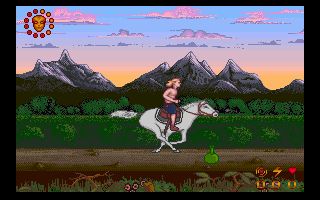
It's a 2D action platformer by Abstrax, set in a fantasy world. You play as a knight on horseback, later on foot, and your goal is to fight your way through hordes of enemies to face the titular demon. Nothing revolutionary on paper, but visually it was a decent piece of work for PC in 1991 — large sprites, smooth movement animation. That wasn't a given for the platform back then.
The gameplay is straightforward and merciless at the same time. You have a weapon, you have a few lives, and enemies will give you a run for your money. Difficulty doesn't ramp up gradually — the game simply throws you in the deep end and sees if you can swim. The horseback combat controls a bit differently than the on-foot sections, and the transition between them works pretty well. The problem is that mistakes are punished immediately and the checkpoint system was, diplomatically speaking, modest. Death means repetition, repetition means memorization, memorization means either mastery or a broken office chair.
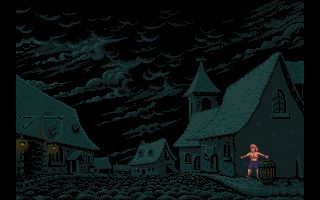
Why I remember it isn't the story — it barely exists. It's that specific arcade loop where the game won't let you progress until you actually improve. Today we'd call that "skill-based design," back then we called it "that damn game." The graphics held up reasonably well over time, the main character's animations are still nice to look at. What hasn't aged as well is the lack of depth — behind the decent visuals lies fairly flat mechanics that get repetitive after a while.
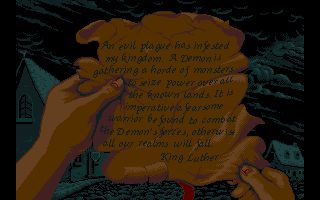
Nowadays, mainly those who want to experience what action gaming looked like on PC when consoles clearly dominated the genre will play it. It's a historically interesting piece of software and a solid three-quarter hour challenge, if you don't mind dying. You can play it in your browser without installation, without DOSBox, and without digging through old diskettes in a box in the attic.
 old
old


 ▶Doom1993MS-DOS / PC


 ▶Contra1988MS-DOS / PC

 ▶Ultimate Mortal Kombat 31996Super Nintendo
