Ulasan ini belum diterjemahkan — kami menampilkan versi asli (English).
Pipes with grout, error after error, and meanwhile nobody knows why anyone would actually play it. Pipes is the game that looked technically and intellectually impressive in DOS graphics mode — and it partially pulled it off.

It's a simple logic puzzle: pipe segments appear on the game board and you have to rotate and arrange them so the entire system works without stopping. Basically Tetris without the falling blocks, without time pressure, and without the stress. The core idea is older than dinosaurs, but in 1983 on PC it looked like something you could kill some time with at the monitor, since there was nothing else to play anyway.
Gameplay is actually boring. You click on pipes, rotate them, wait to see if they connect or not. No time pressure, no urgency — just you, the game, and a moment of peace that would be nice if it didn't feel like you're doing nothing. After ten minutes you know exactly what awaits you in the next twenty. Controls work, graphics are readable, but that's about it. The difficulty doesn't even have any dynamic flow — it's either trivial or you suddenly hit some weird level where you just don't get it anymore.
Pipes made it into history more by existing than by being truly essential. By the nineties, Pipe Dream and later Pipe Mania were far more entertaining — they had time, pressure, actual gameplay. This original Pipes is more of a test bed, a sketch, than a finished product.

Today you'd play it in your browser maybe purely out of curiosity — to see where the pipe-turning craze was born. It's not a bad game, but it's not good either. It's exactly what you'd expect from the tail end of the computer age's infancy: functional, modest, and humorless. If you're in the mood to rotate pipes without effort, it's here for you. Everyone else will want something more substantial.
 old
old


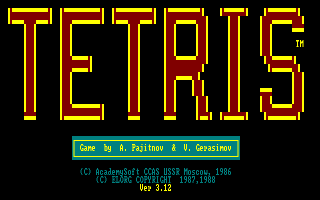 ▶Tetris1985MS-DOS / PC
 ▶Boulder Dash1984MS-DOS / PC
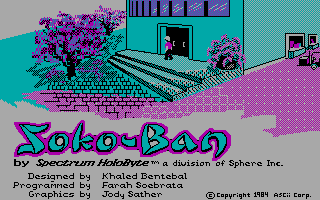 ▶Sokoban1984MS-DOS / PC

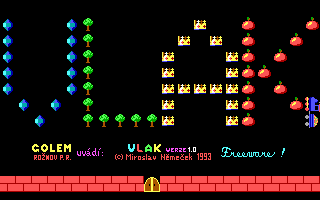 ▶Vlak1993MS-DOS / PC
 ▶Teenage Queen1988MS-DOS / PC

 ▶Chess1998Sega Mega Drive


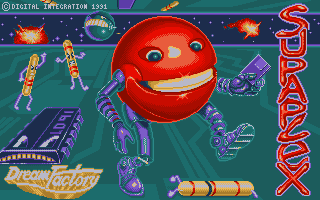 ▶Supaplex1991MS-DOS / PC


