Ulasan ini belum diterjemahkan — kami menampilkan versi asli (English).
I remember staring at that box art and wondering: a plane that hovers in place. How does that even work? MicroProse answered me thoroughly in 1992 — and took several of my weekends in the process.
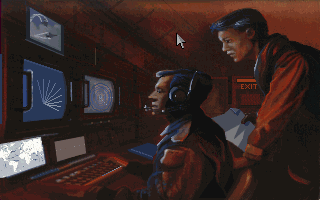
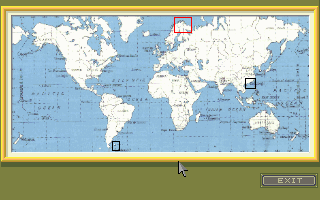
Harrier Jump Jet is a flight simulator built around a single, but absolutely fascinating aircraft: the Harrier, a plane capable of vertical takeoff and landing. MicroProse modeled two variants — the British RAF GR7 and the American naval AV-8B. The campaign scenarios were set in then-future settings: Hong Kong 1996, the Falklands 1997, Norway 1998. These are alternate history today, of course, but at release they felt believable and slightly unsettling at the same time.
The simulator didn't pull punches. You could rotate the vectored thrust of the jets, which is the whole philosophy of the Harrier, and the game forced you to actually learn how to use it. Takeoffs from short carrier decks, landings on rough terrain, slow flight on the edge of a stall — it was all modeled and behaved differently than a regular fighter. The cockpit was detailed, systems worked realistically, missions combined air combat with ground strikes. If you wanted, you could fly with all the assists off; if not, you could enable part of the assists. MicroProse always knew how to do this right.
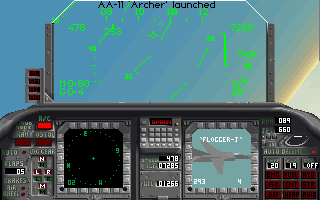
What's aged? The graphics hold up as a period document, not as an experience. VGA in 1992 looked respectable; today it's a necessary evil you have to get through. Enemy AI occasionally has bouts of sudden stupidity. And the documentation — originally a thick manual — is now a necessity, not an afterthought; without it you'll get lost in the systems. On the other hand, the Harrier's flight model has its own logic that works to this day. It's honest work, not a superficial jacket simulator.
Today, Harrier Jump Jet appeals mainly to those who love the history of the genre and are curious how MicroProse approached less conventional aircraft. It's not DCS, don't expect modern precision. But it's a unique piece of nineties sim culture that focused on one specific aircraft and took it seriously. Runs fine in a browser via DOSBox — invest an hour, read up on the basics of thrust vectoring, and you'll understand why the Harrier was such a remarkable machine.
 old
old


 ▶Free Croatia (DOS game)MS-DOS / PC
 ▶Pinball Fantasies1992MS-DOS / PC


 ▶Porky's Strip Poker1993MS-DOS / PC

