Ce test n’est pas encore traduit — nous affichons la version originale (English).
The year 1988. The Cold War was winding down, but nobody knew it yet, and post-nuclear themes were in vogue — from films to comics to games. Chivalry Software released something that looked like an adventure from a devastated world on the box, but under the hood it was something far colder and more analytical.
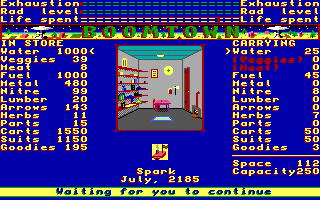
Visions of Aftermath: The Boomtown is a strategy game about surviving after nuclear war. You crawl out of a bunker into a devastated world without a life manual — just the need to survive and gradually build something functional from the rubble. The game gives you the freedom to create your own world or work with a pre-generated one, which was decent comfort for 1988. Genre-wise it balances somewhere between resource management and survival strategy, with a light dusting of adventure that had many people at the time expecting an RPG. They didn't get one.
Gameplay is deliberately austere. You decide about resources, movement, priorities. No real-time action, no battles with cinematic drama — just cold calculations about what you can accomplish and what you can't. Controls on MS-DOS were typical for their time: keyboard, text interfaces, occasional menus that required some patience before you'd understand the navigation logic. Anyone who played anything from MicroProse or similar studios back then was used to it.
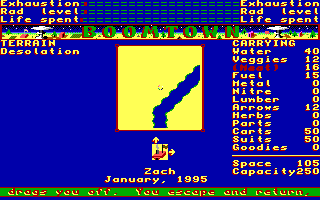
What the game brought that was interesting was the atmosphere of heaviness and isolation — the feeling that the world outside is hostile and you don't have enough information or resources. That sense of uncertainty without a tutorial was intentional in 1988; today half the players would dismiss it as "broken UX". Technically the game aged hard: the graphics are functional, nothing more, and the sound on PC speaker or even Sound Blaster impressed nobody back then either. Still, Boomtown has something — a down-to-earth, mechanical approach to apocalypse that doesn't pay to compare with later Fallout, but in the context of 1988 made sense.
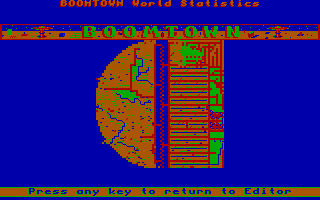
Today it will be played mainly by those with a genuine interest in the history of game design — how studios in the second half of the eighties tried to grasp the complexity of survival without the tools we have today. It's not a game for unwinding or for a night out with beer. It's a game for slow exploration with DOSBox and the willingness to forgive thirty-five years of age. If that doesn't bother you, Boomtown will show you what post-nuclear strategy looked like even before someone named it a genre.
 old
old


 ▶North & South1990MS-DOS / PC


 ▶Sid Meier's Civilization1991MS-DOS / PC


