این نقد هنوز ترجمه نشده است — متن اصلی (English) را نشان میدهیم.
Year 1993, Softdisk Publishing releases Street Ball. But if you had a keen eye, it might have felt familiar — and it should have, because the game already came out as Paragon back in 1991. Identical levels, identical graphics, identical everything. The title screen changed, the rest stood untouched.
The game's roots run even deeper — the original title comes from Commodore 64 in 1988, where it hid under various names in different releases. The DOS version that came with the PC port fundamentally overhauled this: instead of single-screen levels, it offers vertically and horizontally scrolling environments, so compared to the modest original, it's a noticeable step forward. Genre-wise, it's an action arcade game — a ball, obstacles, a goal somewhere at the other end of the level.
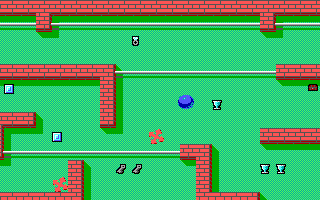
Gameplay is straightforward. You control the player, move around, dodge obstacles and opponents, try to get the ball where it belongs. Nothing that requires a manual. That has its merits — in 1993, you could fire it up and within five minutes you knew what you were doing. The downside of this simplicity is that depth is missing, and that starts to show in longer play sessions. Difficulty ramps up, but variety doesn't quite keep pace.
What can't be overlooked, though, is the very fact of this re-release. Softdisk changed practically nothing. No new levels, no improved graphics, no refined mechanics — just a different logo on the title screen and new packaging. In 1993, when DOS was getting titles that pushed genres forward, that was at least a bold business move. Put more bluntly: recycled goods sold at full price.
Today Street Ball suits anyone interested in pure arcade simplicity without tutorials, cutscenes, and five intro screens with engine logos. The game works in a browser via DOSBox emulation without issues, launches quickly, and demands minimal attention. Perfect for a quick fifteen minutes, then you can close it without guilt. As a historical artifact, it's more interesting as an example of publishing practices back then than as a genre highlight.
 old


 ▶Bubble Bobble1989MS-DOS / PC


