این نقد هنوز ترجمه نشده است — متن اصلی (English) را نشان میدهیم.
Year 1992, and Maxis once again proved that the word "Sim" before a title could mean anything. I understood SimCity right away. SimAnt entertained me. SimLife confused me at first and then captivated me for several evenings in a way I couldn't quite name back then.
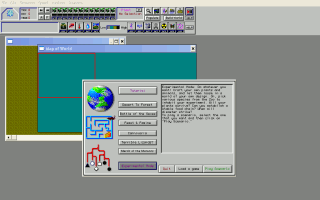
SimLife is an ecosystem simulator. You get a planet, environmental parameters, and a toolkit to create and modify organisms — plants and animals alike. You define their genetic traits, metabolism, behavior, and reproduction methods. Then you release them into the world and watch what happens. Nature — or rather, your nature algorithm — does what it sees fit. Usually something you didn't expect.
For 1992, the controls are handled competently through menus and various panels, but expecting to sit down and have a functioning biosphere in ten minutes would be a mistake. SimLife demands patience and willingness to read. There are plenty of variables — temperature, humidity, nutrient availability, genetic traits of individual species. The game gives you graphs and statistics to work with, so if evolutionary biology entertains you even a little, you've got plenty to sink your teeth into. If not, you'll soon discover your creatures have gone extinct and you have no idea why.
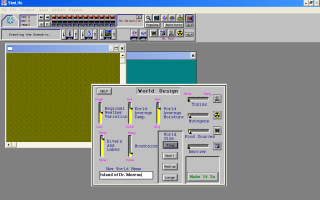
That's actually the key thing that sets SimLife apart from the other "Sim" games: this isn't about building in the classical sense. It's about understanding the system. For its time, the game was incredibly ambitious — Maxis incorporated simplified principles of genetics and ecology in a way that leaned more toward educational software than entertainment in the traditional sense. And that's exactly what SimLife was then and is now — part game, part interactive textbook, part experimental sandbox. The result either fascinates or frustrates depending on your mood.
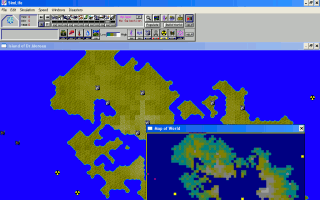
Today SimLife ages strangely. Technically speaking, later simulators could do more. But as an artifact of an era when Maxis believed players wanted genuinely complex systems and wouldn't shy away from reading a manual, it has its value. It suits people who love simulations for their own sake — not for rewards and progression, but for that moment when you realize your herbivore just developed different behavior because you accidentally tweaked its parameters a generation back. If that sounds like a reward, SimLife is for you.
 old
old


 ▶Free Croatia (DOS game)MS-DOS / PC


 ▶Pinball Fantasies1992MS-DOS / PC


