این نقد هنوز ترجمه نشده است — متن اصلی (English) را نشان میدهیم.
I remember staring at the hex map mid-nineties, wondering if that unit in the top left could squeeze in one more attack, or if I should let it sleep a turn behind some terrain cover. Nectaris was exactly the kind of game that would have you staring at the screen for twenty minutes before you clicked.
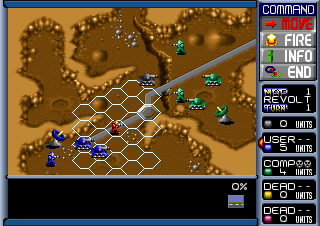
Nectaris originally comes from Japanese Hudson, with the 1995 PC version released under Sunflowers. It's a turn-based strategy set in a space setting — units move across a hexagonal grid, battle for planets and bases, and the overall atmosphere balances somewhere between military sci-fi and strict chess logic. No stories, no cutscenes. Map, units, opponent.
Gameplay rests on a simple foundation that quickly reveals solid depth. You have a base, you have a handful of units, and you have an opponent who thinks like you do — just with the opposite goal. Each unit has different range, attack, and defense, terrain matters, and turn order decides victory and defeat within a single round. Anyone who attacks without thinking will lose. This game teaches you that quickly and without apologies.
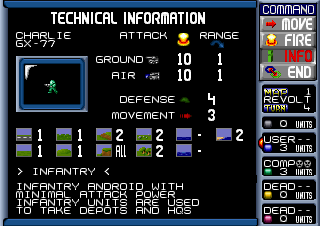
What made Nectaris interesting back then and what paradoxically keeps it alive today is precisely that restraint. No colorful chaos, no hundreds of technologies to research. Just pure tactical confrontation where every move carries weight. Of course, the graphics belong to the year of release and the sound is exactly as ambitious as you'd expect from a mid-nineties PC version — which is to say, not particularly. The interface feels skeletal today and the game will leave you guessing some mechanics through trial and error rather than explanation.
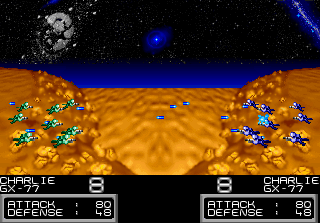
Today Nectaris appeals to someone who enjoys turn-based strategy without the baggage of a hundred-hour tutorial. If you like the idea that one poorly placed unit can decide an entire battle, this title serves it to you in concentrated form. You can play it in your browser without installation and without DOSBox configuration struggles — which is actually a pretty rare advantage for a retro game.
 old
old


 ▶Teenage Queen1988MS-DOS / PC
 ▶North & South1990MS-DOS / PC


 ▶Sid Meier's Civilization1991MS-DOS / PC


