November 1992, the heating isn't working yet and I'm sitting in a winter sweater in front of a monitor that flickers with every scrollbar movement. Eye of the Beholder II is running on Dad's 386 and I know I'm not getting up from this desk today.
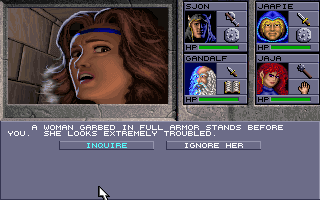
The second installment in the series developed by Westwood Studios for SSI picks up exactly where the first one left off — your party of adventurers is summoned to the temple of Darkmoon, where things are happening that shouldn't be happening. Explorers are vanishing without a trace, priests are acting suspiciously, and somewhere in the depths of the complex, an evil stirs that's looking for a backstab. Setting it in the Forgotten Realms didn't feel like a marketing tag back then — it was a guarantee that anything from a skeleton to a mind flayer could be waiting around the corner.
You play it like a classic real-time dungeon crawler with pause: movement on a grid, a party of up to four characters on the foreground of the screen, combat resolved by clicking on weapons in hand. The system is based on Advanced Dungeons and Dragons second edition rules, so if you knew the difference between THAC0 and Armor Class, you had a head start. If not, you found out the hard way. The difficulty is sometimes jaggedly unforgiving — not because the game cheats, but because resource management and healing allow minimal tolerance for mistakes. One bad fight in the catacombs and you're reloading.
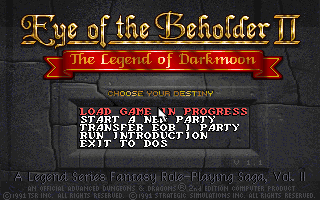
What set the sequel apart from the original was the environment. Darkmoon temple isn't just one dark corridor after another — interiors alternate with outdoor areas, different enemy factions with varying tactics. Beholders, who gave the series its name, are present here and their gaze kills you faster than you can say "dispel magic". The music composed specifically for the DOS version worked as a quiet adrenaline awakener in moments when you least expected it.
Today the game has aged quite admirably in the sense that its core — exploration, resource management decisions, mapping on paper or in your head — still works. What hasn't aged as well is the complete lack of hint system for puzzles. Some puzzles are fair, others are a matter of either having read a gaming magazine from the nineties or pure luck. I personally spent an hour searching for a lever that was literally on the first floor.

Who should play Eye of the Beholder II today? Those who love old-school dungeon crawlers and don't mind the game assuming you have patience and the willingness to take notes. It's playable in a browser via DOSBox emulation without installation, and a few hours in the catacombs of Darkmoon are still worth it — if you know what you're getting into.
 old
old


 ▶Dungeon Master1989MS-DOS / PC


 ▶Pakmon2010MS-DOS / PC
 ▶Doraemon: Giga Zombie no Gyakushuu1990Nintendo NES


 ▶Light Crusader1995Sega Mega Drive