QBasic Nibbles. Anyone who had DOS at home in the nineties knows it. Green snake, white numbers, programming school by example. Super Nibbly by Cosmos from 1993 took it all and wrapped it in a more graphic coat — the snake transformed into a worm and the game got a name that promises maybe a bit more than it can deliver.
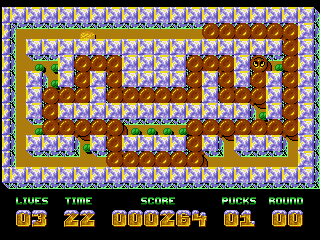
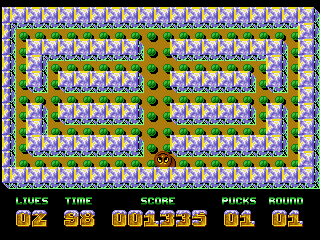
The principle is classic, almost archetypal. A worm moves across the screen, constantly growing. You collect scattered bits of food, each bite extends it, and a time limit ticks above your head like a metronome. The goal is simple: collect everything before time runs out, and don't bite your own tail in the process. Walls, your own body, the timer — a trio of things that will kill you.
Playability is exactly as simple as it sounds. Arrow key controls, no surprising mechanics, no power-ups or bonus levels that would change anything. Difficulty increases naturally — the worm gets longer, maneuvering space gets smaller, and suddenly you realize the route that worked a moment ago will reliably kill you now. That's the part that keeps you at the screen. Visually, the game looks like an honest shareware product of its time: more colorful than the QBasic original, but no graphics revolution. The sounds are roughly at the level you'd expect from a PC speaker, even if you had a SoundBlaster.
No one remembers Super Nibbly because it brought something new. It's remembered — if at all — as one of thousands of minor shareware games that spread on floppies, in BBS archives, and as supplements to computer magazines. Cosmos wasn't reinventing the wheel, they were making reliable vehicles for afternoons without the internet. This game is exactly that: it fills half an hour, then you close it and forget about it. It doesn't promise anything more.
Today, mainly those for whom the word "shareware" triggers a Pavlovian reflex in the form of nostalgia will play it. As a historical artifact of the snake game genre on DOS, it has its place — it shows what small developers' creations looked like in an era when it was enough to copy a functional idea and decorate it a bit. You can run it in a browser via DOSBox or an emulator without problems. Just don't expect to spend more than one afternoon with it.
 old
old


 ▶Prince of Persia 2 - The Shadow & The Flame1993MS-DOS / PC
 ▶Ultimate Mortal Kombat 31996Super Nintendo
