Denne anmeldelse er endnu ikke oversat — vi viser originalen (English).
Year 1990, halfway through the evening, my parents think I'm doing homework. On the monitor instead of a notebook glows an underwater world, and I'm solving math problems so I can shoot at a raging octopus. Educational software that actually entertained me back then — that's not just talk, that's a rare phenomenon.
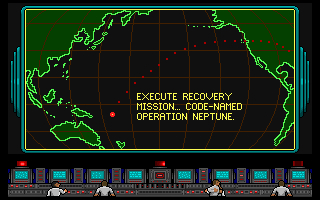
Operation Neptune comes from The Learning Company, an American firm that was releasing educational games with solid gaming foundations back then. The story revolves around a crashed space capsule whose wreckage ended up on the sea floor. You control a submarine, collect scattered fragments, and gradually uncover the expedition's secrets. An underwater maze forms the game space, sea creatures complicate your path.
Math problems form the game's core — various difficulties depending on settings, so the game covered quite a wide age range of elementary school. Without the right answer, the submarine won't shoot, won't move, or simply won't do what you need. The mechanic is straightforward: solve the problem, move on. The underwater section has pleasant fluidity, keyboard controls worked without a hitch. For an educational title from 1990, this was a above-average experience — not frustration, but an actual game where math fit in organically.
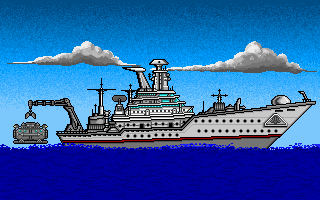
What I remember most about it is the atmosphere. Dark underwater setting, muted graphics in EGA palette, sounds from PC speaker or Sound Blaster depending on your setup — it all created tension you wouldn't expect from educational software. The Learning Company had a good feel back then for where the line between education and play should be. Many of their titles from that era crossed that line on the wrong side and ended up as boring workbooks with pictures. Neptune didn't. Today of course the graphics and sound look archaic, but the game loop — movement, danger, reward — still functions clearly.

I'd recommend it today in two cases. Either you have a child in elementary school and want to gently get them to practice math — and you don't mind that the interface looks prehistoric. Or you grew up on DOS like me and want to remember what educational software looked like when it actually tried. It'll take you half an hour, probably not more. But those thirty minutes will be more fair than most of today's mobile "educational" games combined.
 old
old


 ▶Amazing Spider-Man1989MS-DOS / PC

