Denne anmeldelse er endnu ikke oversat — vi viser originalen (English).
When I was playing on a computer in the first half of the eighties, I focused mainly on text adventures and simple action games. Savage Island Part 1 was the second type — one of the older games that embraced simplicity to the fullest while not trying to be more than it was.
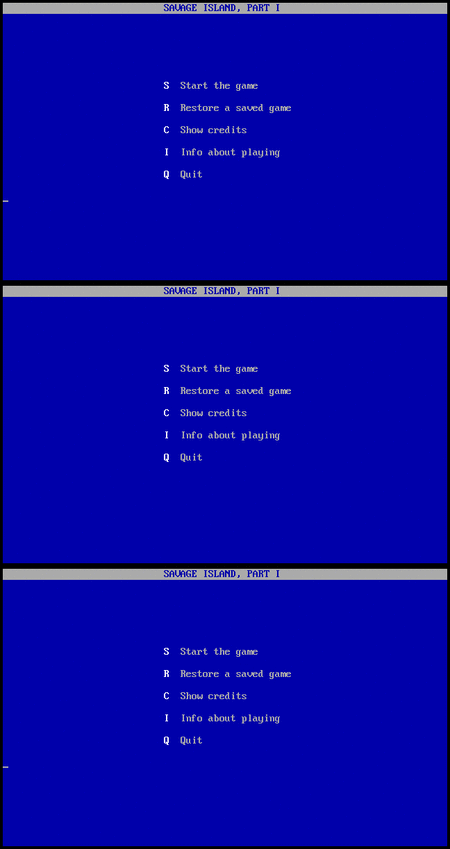
It's a command-line adventure written by Roger Whitaker. Something between pure text and the first graphical adventures — you take on the role of an explorer trapped on a mysterious island and try to find a way out. There's no plot in the modern sense. There's just the goal: find objects, solve simple logical puzzles, and move forward. The graphics consist of ASCII characters and a few simple drawings. Sound? You don't have any. You have to bring the atmosphere yourself.
You play with commands like GO NORTH, GET OBJECT, USE THING. Nothing sophisticated. The mystery lies in not knowing what's useful here and what isn't — you have to try everything. Some objects come in handy later, others not at all. The game has a few truly silly solutions that will block you for a long time simply because you didn't notice a detail. It's frustration you can't avoid, but it's also part of the experience. Walking from room to room without graphics that spell everything out for you — that demands imagination and patience.
In 1980, the game was an expression of what computer games were like in home computers — modest, unrefined, relying heavily on the player's imagination. Today it feels like pretty dull text with occasional ASCII artwork. It's not bad, it just means Savage Island is valued more from a historian's perspective than an enthusiast's.
If you're curious what an archaic computer adventure looked like at the turn of the seventies and eighties, here it is. It's not a game for relaxation — it's more of an archaeological labor. Today you'll play it more for the history than for fun, but that's not a sin.
 old
old


 ▶Amazing Spider-Man1989MS-DOS / PC


 ▶Fantasy - An Adult Game1987ZX Spectrum


