Denne anmeldelse er endnu ikke oversat — vi viser originalen (English).
Summer 1991, summer holidays, dad tells me to go outside, and instead I'm sending divisions across the front line somewhere between Verdun and virtual Berlin. Command H.Q. from Ozark Softscape was exactly the kind of game where I first understood what the word "turn-based strategy" meant — and why it's more dangerous than any action game.

The game offers five conflicts spanning different eras and natures: World War I, World War II, a theoretical third world war with oil fields as a key resource, a speculative fourth world war, and finally a distant futuristic era marked with a question mark. Each scenario has its own units, map, and logic. The further into the future, the more abstract — that futuristic "????" was more of a thought experiment than historical reconstruction, but as an addition to the more realistic campaigns, it worked.
The game's foundation is simple: you command armies, occupy territory, and in later scenarios also oil fields, without which motorized units grind to a halt. The backbone of every army is infantry — cheap, tough, and slow. Mechanized and specialized units come later with higher maintenance demands and supply requirements. Keyboard controls were standard back then, today they feel clunky — but you get used to it in twenty minutes. The turn-based system for two players sharing one keyboard or playing via modem was pretty civilized for 1991.

What set Command H.Q. apart from plenty of contemporary competition was its breadth of scope in one package. Five different epochs in a single box wasn't a given. Graphics were never a strong point — unit icons on the map looked more like geography textbook symbols than an actual army — but that was the standard back then. The Sound Blaster music did its job, nothing more. What has aged worst is the lack of explanation and any tutorial; the game assumes you know what you're doing, or that you'll read the manual. The manual you obviously don't have now.

Today, Command H.Q. will appeal mainly to those who want to experience what turn-based war strategy looked like in an era when it had no ambitions to be a simulator. It's fast, straightforward, and surprisingly lively when played with two players. Fire it up in a browser via DOSBox and it boots in seconds — you'll have your first move made before any modern strategy game even finishes its tutorial. Sometimes that's an advantage.
 old
 Starcraft Wings Of Liberty Blizzard Product T ShirtSe på eBay »

 ▶Teenage Queen1988MS-DOS / PC


 ▶Sid Meier's Civilization1991MS-DOS / PC


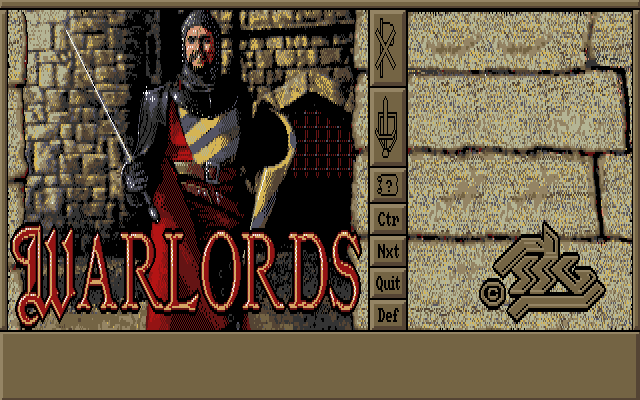 ▶Warlords1990MS-DOS / PC
 ▶Chess1998Sega Mega Drive

 ▶Strip Poker 2 Plus1988MS-DOS / PC