Year 1983, when PC had no standards and every other programmer released their own Frogger or Q*bert clone. J-Bird fell squarely into that second group — and made no bones about it.
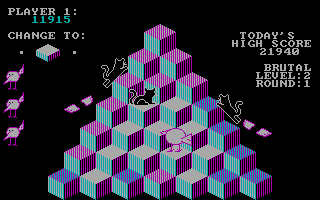
Orion Software took Q*bert, renamed the frog into a bird, added a pyramid of tiles, and wrapped it up as an MS-DOS package. The goal is straightforward: hop across every tile on the pyramid and change its color. Once you pull it off, level cleared. Meanwhile, you're being chased by enemies — red balls that roll down the pyramid with unpleasant regularity.
Controls work on four diagonal directions, which was quite the feat on a 1983 keyboard. The bird's movement is snappy, the red balls have their own rhythm, and after a few attempts you'll start reading their trajectories. Difficulty ramps up naturally — enemies speed up, tiles multiply, and you've got less and less room for error. Nothing original, but the mechanics work, and that counts.
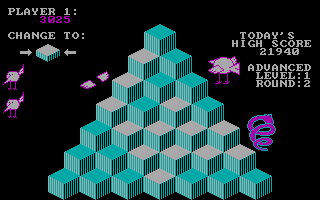
What J-Bird brought was mainly an accessible Q*bert for PC owners who couldn't reach the arcade. Home ports of arcade games were pure gold back then, and Orion Software knew exactly what they were doing. Graphics in CGA palette look today exactly as you'd expect — four colors and a blocky little bird. Sounds through PC speaker are, let's say, authentic. The game aged exactly as you'd think it would: playability survived, audiovisuals did not.
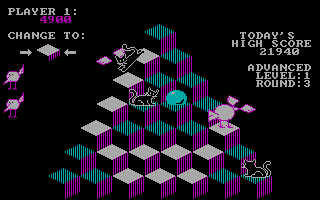
Today J-Bird suits anyone who wants ten minutes of arcade reflex-jumping without installation or tutorials. It's a time capsule from when PC games had no ambitions to be art — just fun during a break. Boot it up in a browser via DOSBox emulator and it launches in a second, and you'll have seen everything in ten minutes. No reason to spend an afternoon with it, but as a reminder of where the genre grew from, it does the job.
 old
old


 ▶Doom1993MS-DOS / PC


