Bài đánh giá này chưa được dịch — chúng tôi hiển thị bản gốc (English).
Somewhere in '88, I was sitting in front of a monitor wondering what this game actually wanted. Trust and Betrayal — Legacy of Siboot wasn't an adventure like I knew them. No parser, no "take lamp". Instead, silence, an alien world, and the feeling that I'd landed in something someone from another planet had dreamed up.
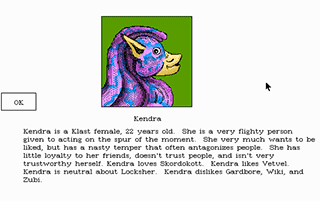
Chris Crawford, who designed the game and released it through Mindscape in 1987, built it on an idea that hardly anyone got back then: social manipulation as game mechanics. The player finds themselves in the Kira colony, where a group of ministers are vying for the title of shepherd — the community leader. No dragons, no swords. Just people, relationships, and mutual distrust.
The core of gameplay consists of communicating with other characters through a symbolic language — a series of icons through which you express emotions, promises, and threats. And then comes what an old review note aptly called rock-paper-scissors: when two characters clash, a simple gesture-choice system decides the outcome, but it's wrapped in layers of bluffing and reading your opponent. It's primitive and yet surprisingly thrilling if you dig the genre.

The problem is that Crawford went so far from convention that the game back then lost the vast majority of players before they understood it. The interface is deliberately abstract, the manual essential, and without patience you won't last longer than twenty minutes. It aged poorly in the sense that it was never accessible — not in 1987, not today. But the idea behind it aged surprisingly well. The systems of trust and betrayal Crawford explored, you see them in every other modern narrative game today.

These days, mainly those who want to understand where experimental games like diplomacy and interpersonal relationship games came from can play it in a browser — or those willing to spend an hour with the manual in hand and then two hours fumbling around, which has its own strange, inexplicable charm. I don't recommend it for tourists. For everyone else, it's a historical artifact worth seeing with your own eyes.
 old

 Secret of Monkey Island Vintage T-Shirt Retro Graphic TeeXem trên AliExpress »
 The Secret of Monkey Island Original Logo Caps CottonXem trên AliExpress »


 ▶Muppet Treasure Island1996MS-DOS / PC


 ▶Bubble Bobble - The Adventure1993ZX Spectrum


 ▶Electro Body1992MS-DOS / PC

