Recenzia zatiaľ nie je preložená — zobrazujeme pôvodné znenie (English).
There are games that make you lose a friend. Not literally, but after two hours of hot-seat in the living room, that person stops answering your questions and starts responding only with grimaces. Hexxagon 2 by Argo Games from 1993 was exactly that silent friendship killer.
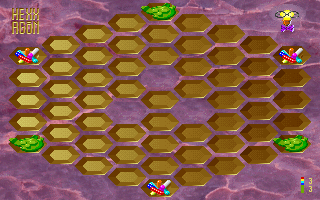
It's a turn-based strategy game on a hexagonal grid — hence the name. Each player controls a group of stones and the goal is to occupy as much of the board as possible. The basic rule is simple: move a stone one space and create a copy of it, jump two spaces and move it instead. All adjacent opponent stones change to your color. This mechanic came from the Atari, where Reversi popularized it and its distant relatives, but the hexagonal grid gave it a new dimension and a good dose of cunning.
Controls are mouse or keyboard, no fuss. You set the difficulty, sit across from each other or play alone against the computer, and you're off. But that's exactly where the game starts to limp. The AI was an easy target back then — even an average player reads it after a few matches and beats it reliably. That doesn't mean the game is bad, just that the real reason you turned it on was that other person sitting across the table from you. Hot-seat worked, and that's a statement in itself for PC gaming in 1993.
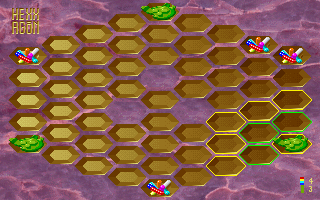
Graphics and sound are things that didn't age badly — they weren't hot even back then. Monochrome surfaces, basic sound effects, no music that would stick in your head. The game knew it and didn't even try to be more than what it was: pure abstraction without frills. Paradoxically, that's where its durability lies. You don't have to admire 1993 graphics, because there aren't any. There's just the game board and decision-making.
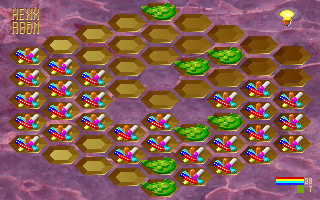
Today Hexxagon 2 suits anyone who wants a short strategic match without installation and without a tutorial. The browser version takes us back exactly where we were — to the table, to the other chair, to the keyboard. Just this time I'd recommend inviting someone you trust. Or no one. The computer won't win, but it won't take the remote control when it leaves either.
 old
old


 ▶Contra1988MS-DOS / PC
 ▶Commander Keen 4: Secret of the Oracle1991MS-DOS / PC


 ▶Toy Story1995Sega Mega Drive
 ▶Dangerous Dave in the Haunted Mansion1991MS-DOS / PC


 ▶Giana Sisters1987MS-DOS / PC
